
Chemtrails and Contrails: A Less Secret Sky, but Not Necessarily a More Reassuring One
Some aircraft trails disappear almost immediately. Others persist, spread and sometimes end up veiling part of the sky. What are they really, why do they behave so differently, and are they as harmless as we tend to assume? Using data from my ADS-B station and the available scientific evidence, I have tried to distinguish what we observe, what we imagine and what we can actually establish.

The trails left by some aircraft are real. Some disappear within seconds, while others persist, spread and sometimes end up veiling part of the sky. They are not imaginary. There is nothing absurd about asking what they contain, why they behave differently and what consequences they may have.
I am neither a climatologist nor an atmospheric scientist. I am simply someone who, when observing a phenomenon and hearing radically opposed explanations, feels the need to understand what can be verified, measured and reasonably concluded.
So I am not going to ask you to choose immediately between “chemtrails” and “simple condensation trails”. Let us first try to separate what we see, what we can measure and how we interpret it.
Because an observation can be correct even when the explanation attached to it is not.
Just a Few Trails in the Sky… Really?
This line of questioning converged with another of my projects: understanding what actually flies over my home.
When we look up, we see a few aircraft. One here, another a little later. That perception makes it difficult to grasp the true volume of traffic: we do not watch the sky all day, not every aircraft leaves a visible trail, and many simply pass unnoticed.
My ADS-B station tells a different story.
On some days in August, it received signals from more than 2,200 distinct aircraft. Not 2,200 messages—it receives far more than that—but more than 2,200 different aircraft over the course of a single day. FlightAware counts a given aircraft only once in this daily total, even if it later reappears within reception range.
This obviously does not mean that 2,200 aircraft flew directly over my house. Depending on aircraft altitude and reception conditions, the station covers roughly a large part of Belgium and sometimes extends beyond its borders. It therefore represents a radio horizon, not a local count of flights over my garden.
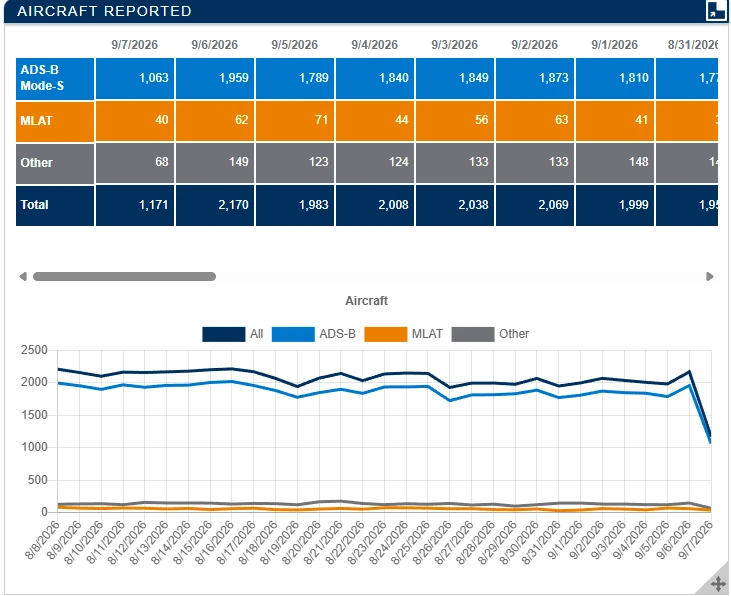
The figure may still seem implausible. Yet it is consistent with the order of magnitude published by skeyes, which reports having handled just over one million movements in 2025—an announced average of 2,743 movements per day—at the airports and within the airspace under its responsibility.
The two figures are not directly comparable. My station counts unique aircraft detected within its radio horizon; skeyes counts movements within a defined operational perimeter. A single aircraft may generate several movements during one day, whereas it will appear only once in my FlightAware total. But the similar orders of magnitude confirm one thing: the data from this small domestic installation reflect a genuine reality. We live beneath extremely busy airspace.
The station does not measure contrails or their effect on the climate. It merely makes visible the volume of activity capable of producing them.
What Does an Aircraft Actually Leave Behind?
A jet engine obviously emits more than water vapour. Burning kerosene notably produces carbon dioxide, water vapour, nitrogen oxides and various particles, including soot.
At cruising altitude—generally around 30,000 to 40,000 feet for an airliner—the hot, humid exhaust gases mix abruptly with the extremely cold surrounding air. When the conditions are right, water vapour condenses around particles and then freezes into tiny ice crystals. It is this multitude of crystals that makes the trail visible.
The comparison with our breath on a cold day helps explain the general principle, but it soon reaches its limits. At high altitude, temperature, pressure and, above all, humidity determine not only whether a trail forms, but also how it evolves.
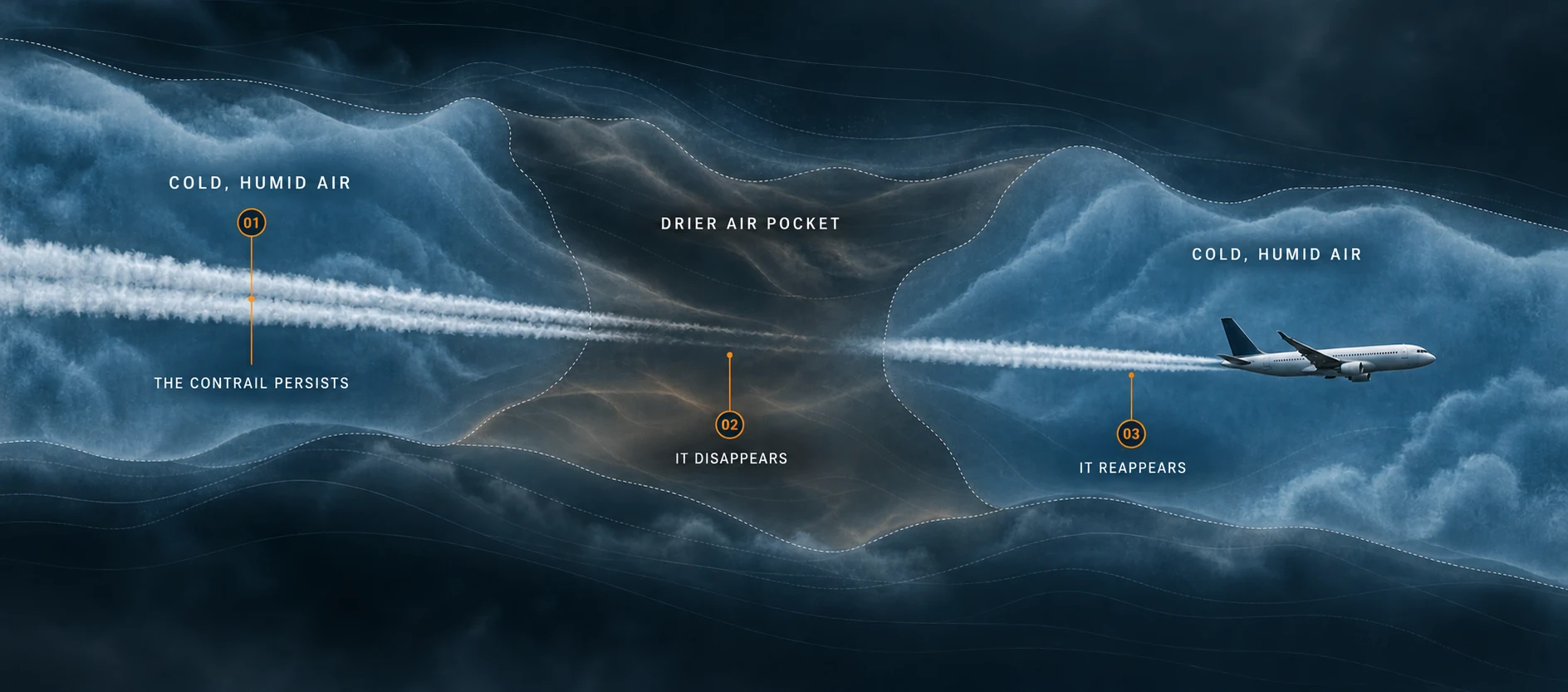
If the surrounding air is sufficiently dry, the crystals rapidly sublimate and the trail disappears. If the air is supersaturated with respect to ice, they can instead persist, grow and be dispersed by the wind. The original line then gradually widens and may contribute to a veil of aviation-induced cirrus cloud.
So the word “condensation” is not wrong. The problem lies in what the reassuring phrase “it is only condensation” can imply.
A Thermocline in the Sky?
Divers are very familiar with thermoclines. After descending only a few metres, you can suddenly pass from relatively pleasant water into a noticeably colder layer. The boundary can be so sharp that it feels like crossing an invisible divide.
During one dive, a friend descended quickly, head first. He later told me that, for a moment, he felt as though he had struck his head against a wall. There was obviously no obstacle in front of him: he had simply passed through a particularly abrupt thermocline.
The atmosphere is not an inverted ocean, and the physical phenomena are not directly comparable. But the experience helps illustrate one essential point: a medium that appears uniform to us can be made up of layers with very different properties, separated by transitions that are sometimes surprisingly sharp.
The air also varies in temperature and humidity. An aircraft may therefore be flying through an area where the conditions allow a trail to form and persist, then enter, moments later, an air mass where it rapidly disappears. From the ground, the trail may appear to begin or end abruptly, even though the aircraft has changed nothing about what it is emitting.
Condensation That Alters the Energy Balance
Like natural cirrus clouds, persistent contrails interact with radiation passing through the atmosphere.
During the day, they can reflect some incoming solar radiation back into space, thereby producing a cooling effect. But they also retain some of the infrared radiation emitted by the Earth towards space, which has the opposite, warming effect. At night, the first mechanism disappears while the second remains.
The balance of a contrail therefore depends on many factors: the time of day, the season, its lifetime, altitude and thickness, the surface and clouds below it, and the atmospheric conditions it encounters. Not all trails have the same effect. Some may even temporarily have a net cooling effect. At the global scale, however, scientific studies conclude that persistent contrails and the cirrus clouds they generate have a net warming effect.
To assess this effect, researchers use a measure known as radiative forcing. Put simply, it describes how a phenomenon changes the balance between the energy the Earth receives and the energy it releases back into space. Positive radiative forcing tends to warm the planet; negative radiative forcing tends to cool it.
The available assessments do not provide a single definitive figure, particularly because the formation and lifetime of contrails depend on atmospheric conditions that are difficult to observe and model precisely.
The main point is simpler than the figures: the climate effect of contrails is significant enough not to be dismissed as a minor detail, but its exact magnitude remains uncertain.
A Few Flights, a Large Share of the Effect
One of the most surprising findings concerns how this effect is distributed.
A study covering some 40 million flights in 2019 estimated that around 24% of flights formed a persistent contrail. Of those flights, approximately 70% are estimated to have produced a net warming effect.
But the effect is extremely concentrated: around 2.7% of all flights are estimated to have accounted for 80% of the cumulative net climate effect attributed to contrails that year.
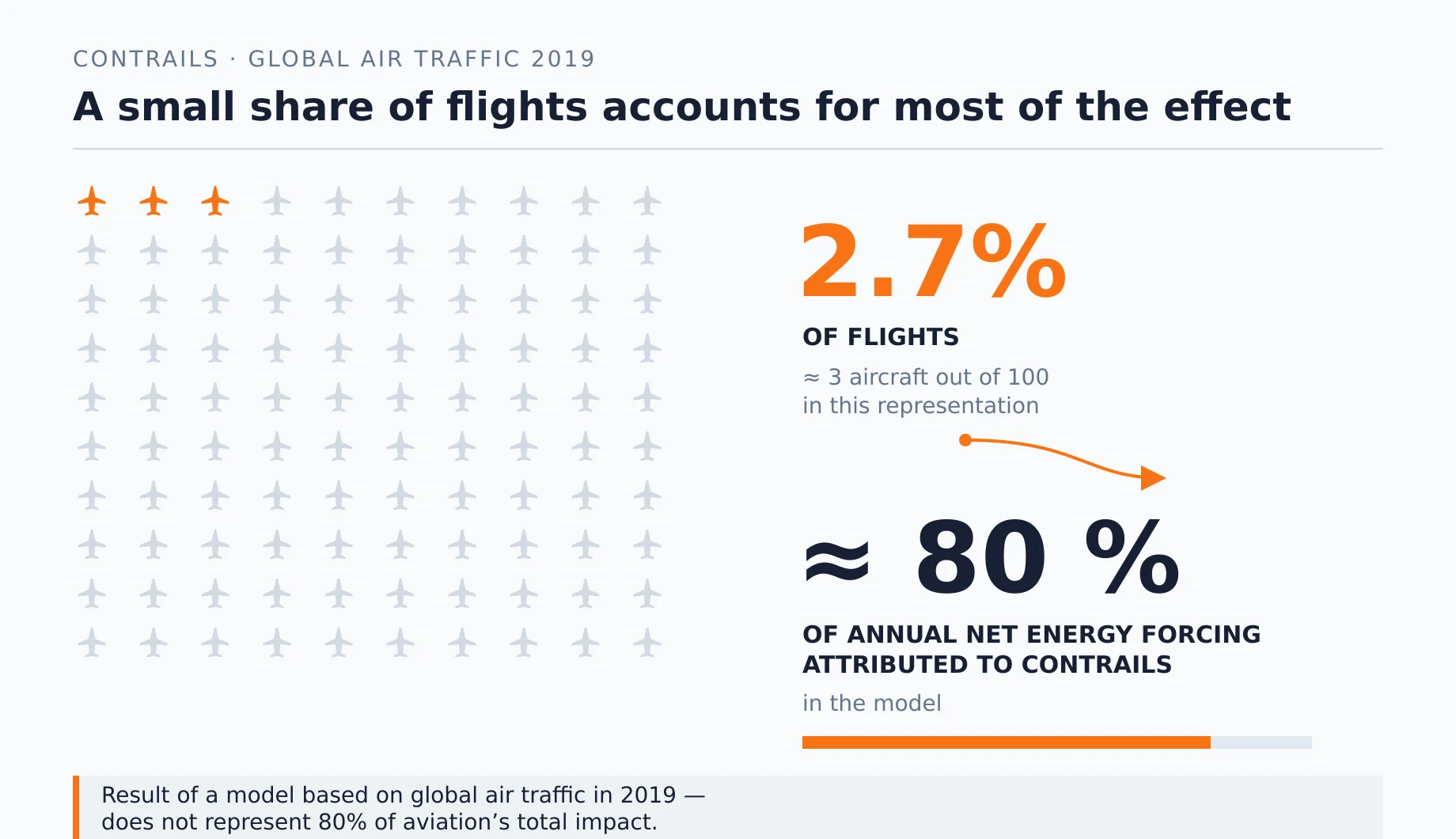
This does not mean that 2.7% of flights were responsible for 80% of aviation-related warming—and certainly not 80% of global warming. The figure concerns only one specific component: contrails. Aviation also emits CO₂, whose effects accumulate and persist for much longer, as well as other substances that alter the atmospheric balance.
Nevertheless, this result shows that certain flights, at certain times and within certain atmospheric layers, have a disproportionate effect. It therefore raises a pragmatic question: could some of that effect be mitigated by identifying these situations and occasionally avoiding the areas most conducive to persistent contrails?
Research is exploring this possibility, but answering the question properly would require a separate article. We would need to forecast these areas accurately, change altitude or route without simply moving the problem elsewhere, and ensure that any additional fuel consumption did not offset part of the intended benefit.
An action does not have to solve everything to solve something.
More Aircraft in Summer, Therefore More Warming?
My station detected as many as 2,200 distinct aircraft per day during July and August. For now, the total appears to be closer to 2,000 aircraft per day, with sometimes significant variations from one day to the next. However, we are still within the summer period, and I do not have a sufficiently long record to determine whether this represents a genuine seasonal change or an ordinary fluctuation in traffic and reception conditions.
We might intuitively assume that this coincidence automatically increases the effect of contrails. But the number of aircraft and the intensity of sunlight are not enough to determine their overall balance.
The same global study instead finds a greater relative effect in winter and a summer minimum in climate forcing per kilometre of persistent contrail. Contrail formation, lifetime, outgoing infrared radiation and reflected sunlight all change together. A seasonal rise in traffic therefore does not mechanically produce a proportional increase in its climate effect.
This is a good illustration of the method followed here: observe a correlation, ask the question it suggests, and then accept that the data may complicate our initial intuition.
And Compared with Cars?
Aircraft are obviously only one part of the climate problem. Globally, road transport emits substantially more CO₂ than aviation: just over six billion tonnes per year, compared with an order of magnitude close to one billion for aviation. Cars and light commercial vehicles together account for more than 60% of road emissions; trucks, although far fewer in number, account for around one-third.
This comparison reminds us that simply counting vehicles is not enough. Their impact depends on fuel consumption, distance travelled, load and operating conditions. There are vastly more cars than aircraft, but an aircraft consumes quantities of fuel on an entirely different scale. There are vastly more cars than trucks, yet heavy goods vehicles produce a disproportionate share of road emissions.
A given quantity of the same fuel produces approximately the same amount of CO₂ whether it is burned at ground level or at altitude. But it does not necessarily produce the same overall effect. At cruising altitude, nitrogen oxides, water vapour and particles interact with a particular environment and may notably contribute to contrail formation.
This does not simply mean that a litre burned at altitude “pollutes more”. At ground level, some emissions have more direct local health consequences; at altitude, other mechanisms have a greater influence on the climate. These are different effects, and a comparison limited to tonnes of CO₂ cannot fully describe them.
So, Chemtrails or Contrails?
Known physical processes explain why trails appear, stop, persist and spread. The scientific and meteorological organisations consulted report no credible evidence of a clandestine programme involving aircraft spraying the substances generally associated with “chemtrails”.
That does not mean that nothing is happening in the sky.
Aircraft burn fuel, emit various substances and can produce artificial clouds with a real climate effect. The reality is less secret than the chemtrail theory suggests, but it is not necessarily entirely reassuring.
The distinction matters. Recognising the consequences of contrails does not validate the chemtrail theory. Rejecting that theory should not lead us to describe contrails as mere white streaks with no consequences either.
We can abandon an unsupported explanation without abandoning the question that gave rise to it.
An Approach That Could Be Applied Elsewhere?
This way of approaching chemtrails might perhaps apply to other conspiracy theories, without claiming that they all arise from the same mechanisms or should receive the same response.
Consider vaccine hesitancy briefly. It is scientifically recognised that a vaccine can cause adverse effects and, much more rarely, serious complications. That risk is not a conspiracy theory: it is studied, monitored and weighed against the expected benefits and the risks posed by the disease. Its use is considered acceptable when this analysis concludes that the benefits sufficiently outweigh the risks for a given population and in a given context. Health authorities are then responsible for continuously monitoring this benefit-risk balance through pharmacovigilance. However, this system is neither automatic nor infallible: history has shown that signals can be detected late, misinterpreted or inadequately communicated. That is precisely why this surveillance must remain transparent, open to scrutiny and receptive to criticism.
Recognising this genuine risk does not validate the idea that all vaccines are broadly useless, dangerous or administered with harmful intent. As with contrails, a kernel of reality can become the starting point for a conclusion far broader than the evidence supports.
The parallel extends only to the approach. Contrails and vaccination are very different subjects, and their data, consequences and methods of assessment are not comparable.
But they invite us to ask the same question: can we take a concern seriously without automatically accepting the explanation that accompanies it?
Finding Common Ground Again
Responding with contempt is rarely a good way to persuade someone. Responding with complacency is no better.
Perhaps there is some common ground to be found here. There is no evidence that aircraft are secretly spraying mysterious substances on us. But that does not mean that the trails they leave behind are necessarily harmless.
It then becomes possible to continue questioning what is happening in the sky without having to maintain an explanation that does not withstand the available evidence. Conversely, rejecting that explanation should not lead us to dismiss the real phenomenon with a shrug and an “it’s only condensation”.
Each side can therefore shift part of its position without being humiliated or cast as the loser of the debate.
We will probably not all agree on everything. But if we can distinguish what we observe, what we assume and what we can demonstrate, we may rediscover a space in which to talk without having to confront one another.
The problem may not be what is supposedly being hidden from us in the sky. It may be what is right before our eyes, what we are only beginning to measure, and what we still discuss far too little.
Main Sources
- David S. Lee et al., The contribution of global aviation to anthropogenic climate forcing for 2000 to 2018, Atmospheric Environment, 2021.
- Roger Teoh et al., Global aviation contrail climate effects from 2019 to 2021, Atmospheric Chemistry and Physics, 2024.
- EASA, European Aviation Environmental Report 2025.
- International Energy Agency, Road transport – Breakthrough Agenda Report 2025.
- skeyes, Annual Report 2025.
- FlightAware, Frequently Asked Questions – ADS-B statistics.
- US Environmental Protection Agency, Information on Contrails from Aircraft.
- UK Government, Aircraft contrails: frequently asked questions.
- European Medicines Agency, Vaccine-preventable diseases: key facts.
- Belgian Federal Agency for Medicines and Health Products, Questions et réponses sur les effets indésirables et la pharmacovigilance vaccinale.
Comments
No comments in English yet.
There is 1 comment in another language.
Add a comment