Does AI Think in the Shower?
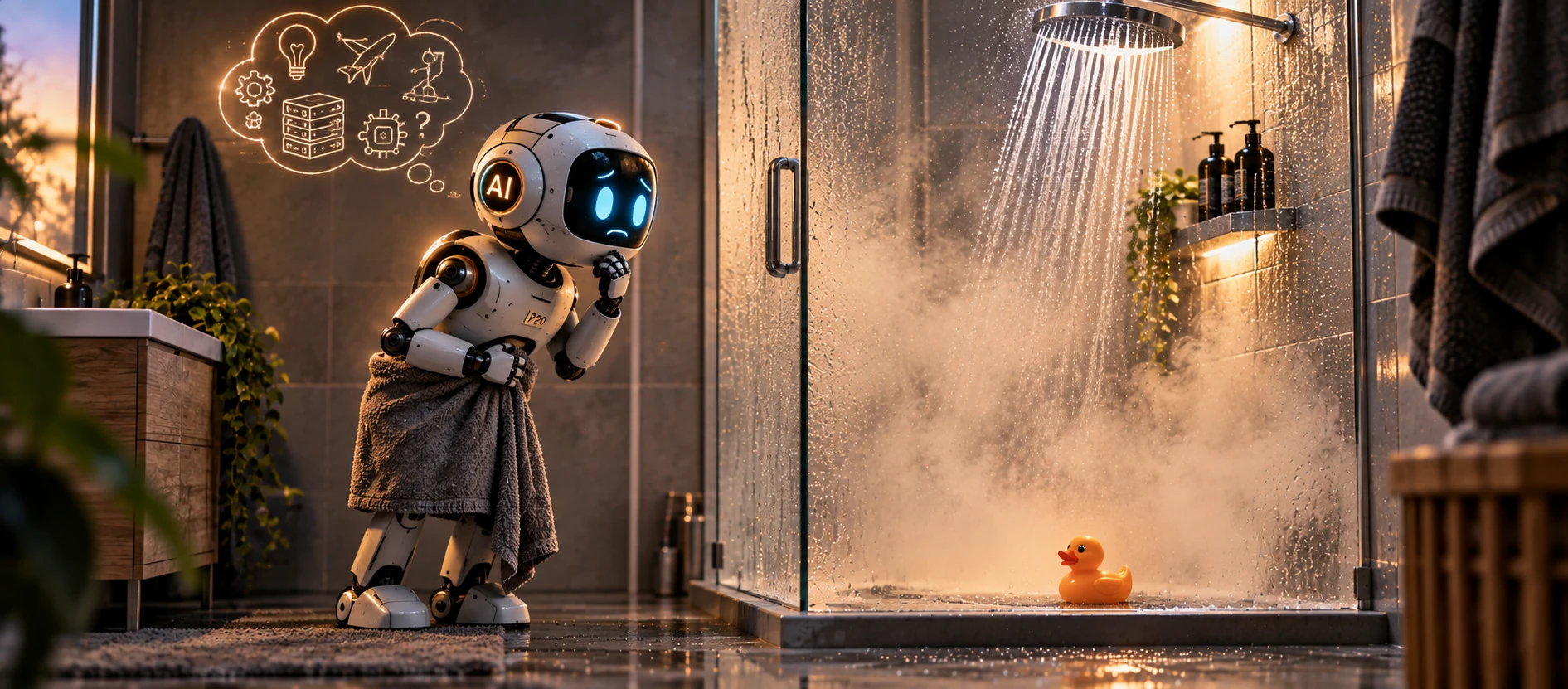
This morning, the radio had apparently decided to talk to me about artificial intelligence.
Three stories in a row, three completely different angles. And inevitably, a few minutes later, in the shower, my brain decided to carry on by itself.
Why are so many people wary of AI? Am I using it sensibly myself? Is it really a machine that "thinks"? Is it going to replace us? Make us stupid? Kill us all within five years?
In short, a perfectly relaxing shower.
A machine that thinks?
I think part of our strange relationship with artificial intelligence comes from its very name, and from the way we interact with it today.
I ask a question, it answers. I present an argument, it challenges it. I make a joke, it understands it --- or at least gives a sufficiently convincing impression that it does.
And language happens to be one of the main ways in which we recognise intelligence in other human beings. So it becomes terribly easy to take one extra mental step: it talks to me like someone, therefore something must be thinking behind the screen.
That reflex is nothing new, by the way. It has even had a name since 1966: the "ELIZA effect", named after one of the earliest chatbots, which simply reformulated users' sentences as questions in the manner of a psychotherapist. Despite the radical simplicity of the program, some users began sharing intimate details with it, convinced that it genuinely understood them.
Perhaps we haven't changed all that much.
Reality is obviously much more complicated. And paradoxically, understanding a few very simple principles about how AI works is already enough to make us look at it rather differently.
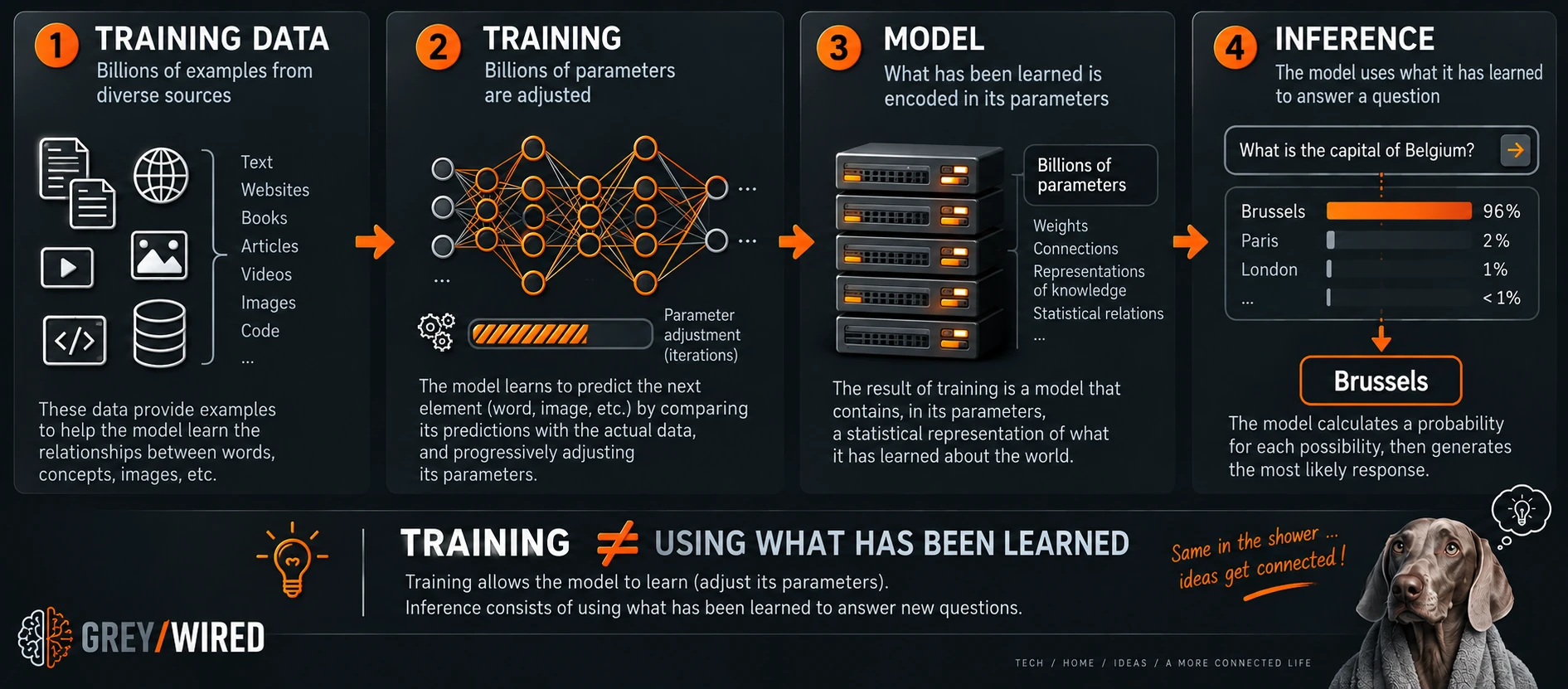
Neural networks certainly didn't appear with ChatGPT either. Their origins go back several decades, and they were already being used in countless applications before the general public started chatting with them every day: speech recognition, image analysis, translation, fraud detection, spam filtering, recommendation systems.
We were already using "AI" without necessarily calling it that. The difference is that a spam filter quietly moving a message into a folder doesn't make anyone think it has a personality. A system that answers us in our own language is a different matter.
"AI" doesn't really exist either
Or rather, what we now call AI encompasses a huge range of different technologies.
This has become particularly invisible with tools such as ChatGPT. I can ask it for an explanation, then ask it to look at an image, then ask it to generate an illustration. From my perspective as a user, I have remained in the same conversation with "the same AI".
Under the hood, things are considerably less straightforward. A model designed for language and a model designed to generate images are not necessarily trained in the same way, on the same data, or even to solve the same kind of problem. Other specialised tools may also become involved. The interface makes all of this transparent --- which is extremely convenient, but probably reinforces the impression that what we have in front of us is a single intelligence capable of doing everything.
One of the things my own use of these tools quickly taught me is precisely how extraordinarily... strange their abilities can be. An AI can accomplish something in seconds that I would be completely incapable of doing, then fail miserably at a task that would take me thirty seconds.
I've experienced this repeatedly with electrical diagrams. Explain a circuit to an AI and it may be perfectly capable of discussing how it works, suggesting components or drawing attention to potential problems. Ask an image generator to produce the corresponding schematic, however, and things can become considerably more entertaining: a wire going to the wrong place, an extra terminal magically appearing, two conductors connecting when they shouldn't. Visually, it can look wonderfully like an electrical schematic. Electrically, rather less so.
To a human who knows the subject, the error may look ridiculous. To the model, producing something that looks like a coherent schematic and guaranteeing the exact topology of an electrical circuit are two very different problems. That is quite an important lesson: what seems simple to us is not necessarily simple for an AI, and vice versa.
And I'm not saying this merely because I've watched AI get things wrong. I've been fooled myself.
My electrical wiring adventures are actually a good example. Faced with a plausible answer, clearly explained and roughly matching what I expected to see, I've sometimes moved too quickly and failed to spot the mistake immediately.
That's probably one of the things that has made me more careful over time.
I'll get fooled again. The objective isn't to become infallible, but to learn to recognise situations where an error is possible --- and above all, to arrange things so that such an error has as few consequences as possible.
A bad suggestion for rephrasing a paragraph will probably have no consequences whatsoever. A bad command executed as root, or a mistake in electrical wiring, considerably more.
The greater the potential consequences, the more rigorous my verification needs to be.
An assistant rather than a replacement
For a long time, I was fairly reluctant to really start using AI --- probably because I had this feeling that once I began handing certain things over to it, I would gradually lose control. Curiously, almost the opposite happened.
Today, I see AI as an incredible assistant, a kind of catalyst. It helps me structure a thought, challenge an idea, explore several possibilities, research something, analyse a problem or simply get started on a project I would probably otherwise have continued putting off.
This website is an excellent example. For a long time, I wanted to share some of my experiences, and for a long time I didn't --- partly because I never considered myself particularly good at writing articles. And yet, perhaps wrongly, I felt I had a few interesting things to talk about. AI helped me cross that barrier.
It didn't live those experiences for me. It didn't build my projects. It didn't decide what I wanted to talk about. But it helps me organise all of that and gives me a kind of permanent outside perspective. Is that positive? From my point of view, yes --- although someone else could perfectly reasonably see it differently.
What I've mainly discovered is that the way I use the tool probably matters just as much as the tool itself.
Take something as mundane as an email. I could quite easily throw three ideas into a window and ask the AI:
Write me an email from this.
I generally prefer to write the email myself and then ask what it thinks. It's slower, but the result isn't my only objective. When certain corrections keep coming back, they also allow me to reassess my own writing style: a sentence that's too long, an unnecessarily complicated formulation, a tone that could be misinterpreted. Over time, I can start correcting some of those weaknesses myself.
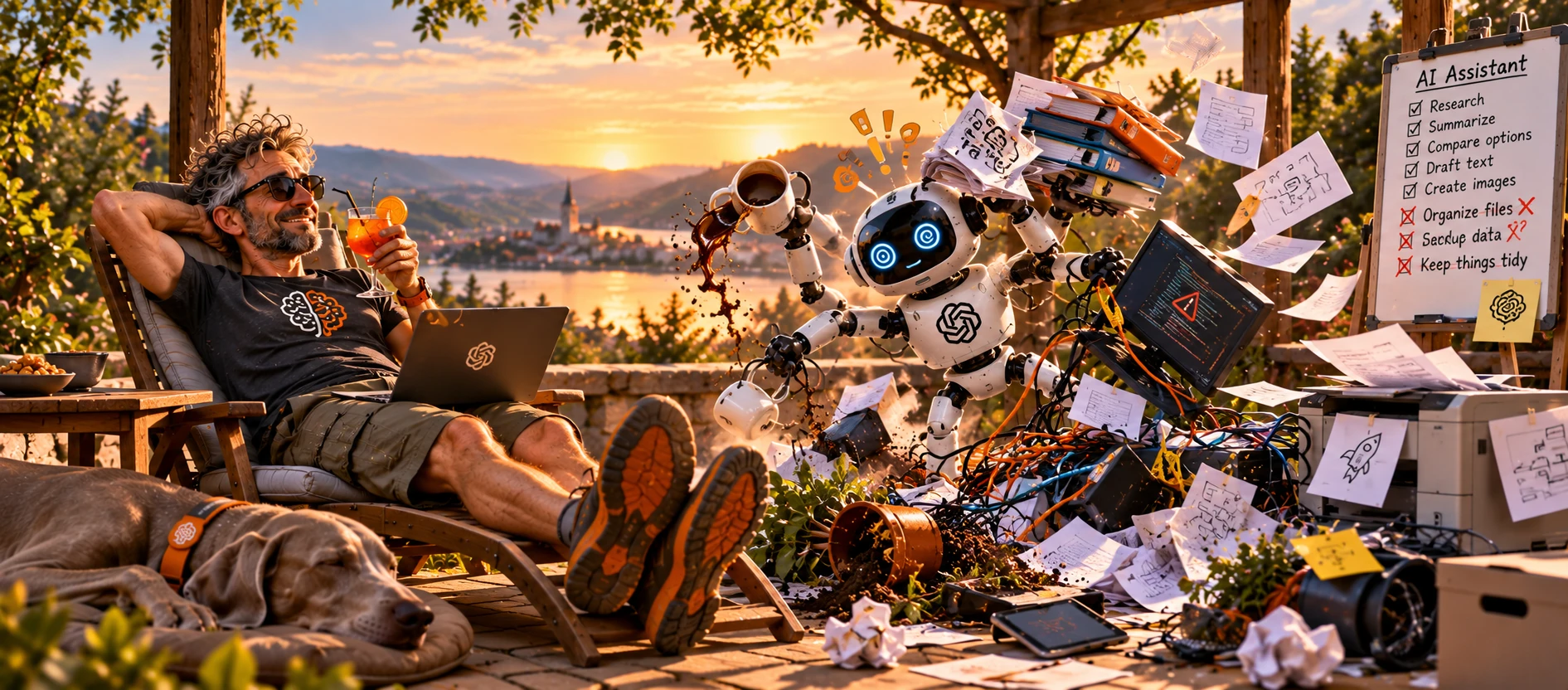
There is therefore an important difference between:
problem → AI → result → copy/paste
and:
I do it → AI critiques → I understand → I correct → I learn
In both cases, I've "used AI". But they aren't quite the same kind of use.
Ultimately, I'm not looking for an AI that does things instead of me. I'm looking for an AI that helps me do things better myself.
What if we all had an assistant?
What's interesting is that this logic is by no means limited to IT people.
My wife is a kindergarten teacher. At first glance, you might wonder what artificial intelligence has to do with that. And yet she finds uses for it too. When she's preparing an activity for her pupils and needs the background removed from an image, why should she spend twenty minutes manually cutting it out if a tool can do it properly in a few seconds? Those twenty minutes aren't what gives her profession its value. She can spend them preparing the activity itself, thinking about how to use it, or simply devoting more time to something that will genuinely benefit the children.
Automating a task does not necessarily mean automating a profession. In fact, that's probably where I currently see one of AI's most interesting uses: freeing us from some of the tasks where our presence adds little value, leaving us more time for the ones where it adds a great deal.
Obviously, there is another way of looking at this. If someone equipped with AI can perform more work, some people will immediately see an opportunity to reduce headcount --- and that will certainly happen in some fields; I'm not pretending that the issue simply disappears if we phrase it differently. But systematically reducing the question to:
How many people can we replace?
seems to me a terribly impoverished way of looking at this technology. I'd rather ask the opposite question:
What could this person do better if they suddenly had an extremely capable personal assistant?
If the assistant eventually performs 90% of a task, great. Perhaps the human can then spend their time improving the process, imagining something new, solving the genuinely difficult remaining 10%, or simply asking why we've been doing the task this way for the past fifteen years.
A human being's value doesn't necessarily lie in continuing to turn every screw. But I want the human to remain the one who decides why we're building the machine.
Who decides?
This is probably where I currently draw my main line.
I have no problem asking AI to analyse data, look for anomalies, suggest several hypotheses, compare different solutions, challenge my reasoning or look for something I may have missed. All of that can help me make a better decision.
I'm considerably less enthusiastic about telling it:
Decide for me.
And even less:
Decide and act without bothering me.
For me, the chain should look more like this:
data → AI → analysis → options → human → decision → action
But something is still missing from that representation: the human needs to understand enough of what the AI is proposing. Otherwise, their presence in the loop is merely an illusion.
Imagine someone who knows practically nothing about computers asking an AI to repair their PC. The AI replies:
Open PowerShell as administrator and run this command.
They copy the command, press Enter and hope for the best. Who actually made the decision? Being the human who presses Enter does not necessarily mean being the human who decides. And the greater the potential consequences of an error, the more critical that problem becomes.
Perhaps the problem is less artificial than human
We regularly hear fairly apocalyptic predictions about artificial intelligence. "AI will kill us all within five years" is one I've already heard several times. I obviously have no idea what AI systems will be capable of in five, ten or twenty years.
But stepping back for a moment, humanity has already demonstrated a rather remarkable ability to invent its own ways of putting itself in danger. Nuclear energy can generate electricity or destroy a city. The Internet can put an extraordinary amount of knowledge within a few clicks, or spread nonsense to millions of people within hours. To me, social networks are wonderful tools for communicating and maintaining relationships; they can also amplify misinformation, polarisation and harassment, or simply our tendency to lose forty minutes watching content we absolutely didn't need.
That doesn't mean technology is neutral or has no risks of its own. How it is designed matters enormously. An algorithm asked to maximise the amount of time spent on a platform has no intrinsic reason to wonder whether those forty minutes were useful to the person who spent them there: it optimises what it was asked to optimise. Design choices, commercial objectives, regulation and user behaviour all contribute to the result.
Douyin, TikTok's Chinese cousin, is an interesting example. The two platforms operate in very different regulatory environments: in China, authenticated users under 14 are automatically placed in "Youth Mode", limited to forty minutes of use per day and unavailable between 10 p.m. and 6 a.m. Content is also filtered, with videos about science, museums, the arts, history and discovery among those specifically promoted.
The political model and the degree of control that comes with it can obviously be debated. But it reminds us of at least one thing: an algorithm is not a force of nature. Humans decide what it should optimise, what it is allowed to promote and what limits are imposed on it.
The issue seems fairly similar to me with AI. The risks are real. But a significant part of those risks will depend on what we decide to do with these tools, how much trust we place in them and our ability to understand their limitations.
So what about those who opt out?
Take two cyclists of perfectly comparable ability. Same training, same equipment, same physical capabilities.
Now imagine a slightly strange world in which doping is legal, available to everyone and, for the purposes of this thought experiment, completely safe. One cyclist decides to use it. The other prefers not to.
The second cyclist hasn't suddenly become worse. They have exactly the same abilities they had yesterday.
But they are no longer starting with the same chances.
The analogy is deliberately provocative --- using AI obviously isn't cheating or doping --- but it illustrates rather well a question I've been thinking about.
Two engineers can have comparable skills. If one uses AI to speed up certain searches, explore an initial scripting approach, spot anomalies, challenge hypotheses or review documentation, they have an amplifier that the other has chosen not to use.

That doesn't automatically make the first person a better engineer. They still need to know how to use the tool, understand its answers and spot its mistakes.
But with equivalent skills, they may become faster or be able to explore more possibilities in the same amount of time.
And that's probably where the question becomes genuinely interesting.
If a few people use this amplifier, they gain an advantage. If tomorrow the entire peloton uses it, that advantage gradually disappears: what was an individual advantage yesterday simply becomes the expected level of performance tomorrow.
The person who chooses not to use it hasn't become less competent.
The frame of reference around them has changed.
Which leads to a slightly uncomfortable question: if an enhancement to our capabilities is permitted, accessible and eventually becomes the norm, to what extent can choosing not to use it really remain without consequences?
Learning to drive
Ultimately, after turning all of this over in my head in the shower, I keep coming back to the same thing: education. Or, more generally, training.
We don't all need to become neural-network specialists, understand the mathematics of a Transformer or know how to train a model. But if these tools are going to occupy an increasing place in our lives, we need a minimum foundation that allows us to understand what they do --- and, above all, what they don't do.
Knowing that an LLM can produce a perfectly written and perfectly false answer. Knowing that a convincing image is not evidence. Knowing that a tool that is excellent in one field can be surprisingly poor in another. Knowing how to verify information. And knowing when we simply don't have enough knowledge ourselves to evaluate what the tool is proposing.
The greater the consequences of a mistake, the less:
"AI told me to do it."
constitutes an acceptable justification.
Perhaps the real challenge of the coming years won't therefore be merely learning how to use artificial intelligence. We'll need to learn how to use it without stopping thinking.
I don't know whether AI represents a new industrial revolution --- we probably don't yet have enough hindsight to know. Nor do I know what place it will occupy in our lives twenty years from now. But I find it increasingly difficult to imagine it simply disappearing.
So we might as well try to understand the tool, decide what place we want to give it, and learn to take advantage of its capabilities without surrendering our critical thinking to it.
There's a great deal of discussion about the need to make artificial intelligence increasingly intelligent. Perhaps we should devote at least as much energy to teaching humans how to use it well.
After all these thoughts, I obviously didn't emerge from the shower with the answer to what artificial intelligence will be in twenty years. But I did come out with one conviction a little stronger than before: before asking how far it can think in our place, perhaps we'd better understand what it actually does --- and keep thinking for ourselves.
AI probably doesn't think in the shower.
Apparently, I do.
Sources for further reading
The ELIZA effect --- Weizenbaum Institute
Joseph Weizenbaum, ELIZA, and our tendency to attribute understanding, intelligence or empathy to a machine once it becomes sufficiently good at talking to us.Douyin and "Youth Mode" --- The Paper / Douyin announcement
Introduced for authenticated users under 14: forty minutes of use per day, no access between 10 p.m. and 6 a.m., and a selection of content including science, museums, the arts, history and discovery.
For this last source, I strongly recommend an online translation tool. :-)
Comments
No comments yet.
Add a comment