The Problem Is Sometimes at the Other End of the Leash
A dog walk, a few tense moments, and plenty of observation. A personal reflection on what our dogs learn from us, our responsibilities as owners, and how we might support them better rather than simply trying to control them.
The Problem Is Sometimes at the Other End of the Leash
What a simple dog walk taught me --- once again --- about dogs, their owners... and myself.
I am not a dog trainer, a behaviourist or a veterinarian. I have simply shared my life with dogs for long enough to have acquired one certainty: the more I learn about them, the less inclined I am to claim that I understand everything.
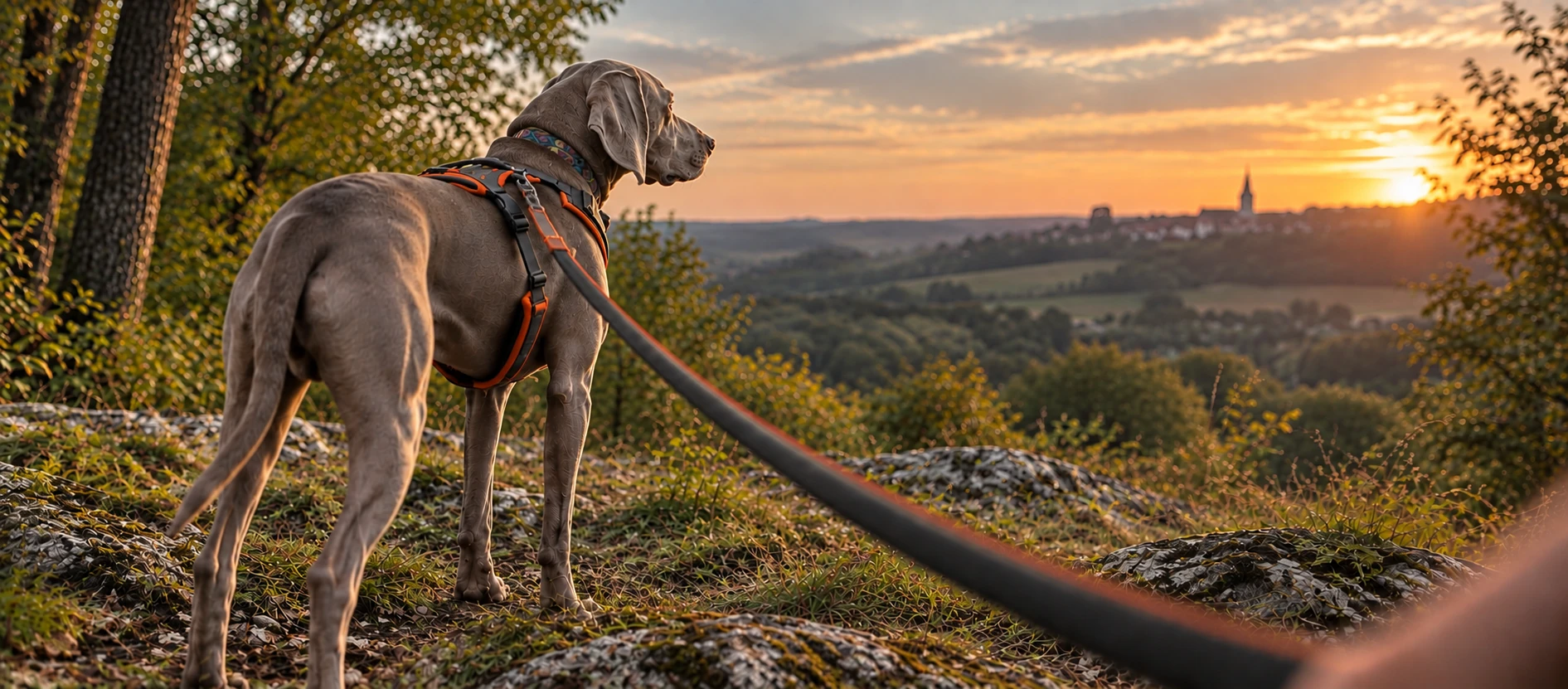
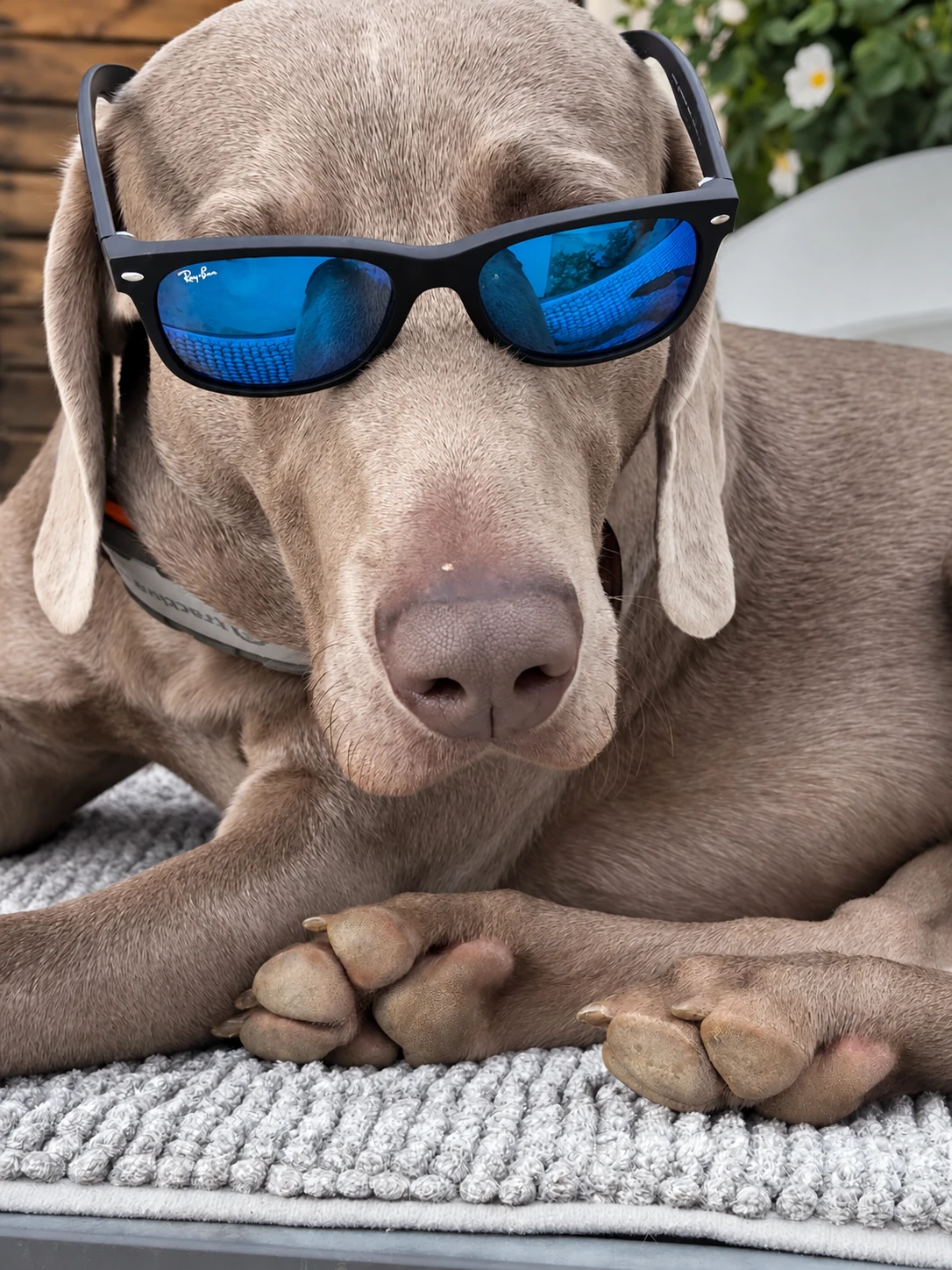
I spent nearly fourteen years with a Rottweiler, eight years with a Tosa Inu, and today I share my daily life with Kiss, a Weimaraner who is obviously the most beautiful, intelligent and well-behaved dog on the planet. That last statement may be slightly biased.
For as long as I can remember, I have felt a need that is difficult to explain to live with a dog, and losing one has always felt much more like losing a member of the family than losing a "pet". But living with dogs does not necessarily mean understanding them. This weekend, a simple walk organised by our dog club gave me yet another rather nice demonstration of that.
A car park full of dogs
The plan was simple: a long walk followed by a barbecue at the club. At the start, dogs and owners all gather in the same place, which already creates, for us, a cheerful mess of leads, conversations, barking and movement. For them, you have to add a world that almost completely escapes us: smells. Dogs they know, others they do not, humans, traces left before we arrived... In short, a particularly stimulating environment.
At moments like these, our dogs do not always display the socially perfect behaviour we would like to show off. One pulls to reach a friend, another barks, a third makes it very clear that another dog is becoming a little too insistent. And we humans start to tense up: because our dog is pulling, because he is barking, because other people are watching, because we are already anticipating what might happen. Perhaps also, sometimes, because his behaviour reflects an image of ourselves that makes us uncomfortable.
Because we observe our dogs, but they observe us too. That is one of the things it took me the longest to fully appreciate. We talk about dog training as though it were a one-way process: I train my dog, I teach him to sit, to come back, to walk properly, not to jump, to wait. But all that time, he is learning too. He observes our posture, our voice, our habits, our reactions. He often knows before we do that we are about to go out. And when we become tense, something happens at our end of the lead: the dog gets excited, pulls or barks, the owner becomes irritated or worried, the lead tightens, the situation becomes more emotionally charged, the dog reacts more strongly, and the owner becomes even more tense.
This mechanism obviously does not explain every canine behaviour; that would simply be replacing one oversimplification with another. But it forces us to ask an uncomfortable question: before trying to correct my dog's behaviour, am I humble enough to ask myself how much of that behaviour I may be reinforcing myself? I can say this all the more easily because it has happened to me. And it still does.
A dog and her owner standing slightly apart
In the car park, a woman was standing a little away from the group with her dog. Situations like this awaken in me an almost irresistible urge to put my big feet right in it. So I walked over with Kiss. (Someone who stays apart may have good reasons for doing so, and I would not advise anyone to imitate me without first asking.) The owner stiffened slightly. So did the lead. But the encounter went well.
Her dog was fairly enthusiastic, perhaps a little intrusive, but Kiss clearly did not care very much. He has his own little escalation when a situation starts to annoy him: look away, perhaps growl and, if the message still does not get through, do what his owner affectionately calls "making his ugly face". I am not claiming to provide a universal translation of canine language: a growl or bared teeth must be interpreted in context and can obviously signal a dangerous situation. But not every disagreement between dogs is an attempted murder.
A little later, another female dog approached. There were a few seconds of tension, with the first dog making it clear that she did not want that proximity. Then it stopped. Her owner, however, was much more affected by the incident than the dogs were. We often do this: we remember the three seconds during which something went wrong far more readily than the twenty minutes during which absolutely nothing happened. Our brains are not very good at keeping track of non-events.
Watching the film rather than the photograph
Perhaps that is another common mistake: we photograph behaviour. A dog growls, makes a brief charge, bares its teeth. Taken in isolation, the moment can look dramatic. But what increasingly interests me is the film.
What happened before? What did the other dog do? How far apart were they, and could they move away? What happened immediately afterwards: did the dog remain focused on the conflict, or did it simply go back to what it was doing? And above all, was this an exceptional event, or a behaviour that keeps recurring and getting worse? Understanding does not mean minimising: genuinely dangerous behaviour must be taken seriously. But a disagreement is not necessarily a failure of socialisation.
Then we started walking
The walk lasted almost three hours, and something interesting happened: the humans started talking to one another. We walked, stopped, started again. The dogs moved along with us, sniffed, watched, came closer or moved farther away as much as their leads allowed. Gradually, we stopped watching them, and they began to get on with their own business.
I spent quite a while talking with a friend whose male dog can be rather pushy. He and Kiss have had a few tense exchanges in the past. For a large part of the walk, they royally ignored one another. We were almost proud of our dogs. Or of ourselves. Probably both. Kiss, meanwhile, was carrying out his usual neighbourhood-watch duties: getting on with his own life while keeping a vague eye on whatever the rest of the group was doing.
That normalisation seems essential to me. The club's training ground allows dogs to learn; a walk sometimes allows us to understand. The dog is no longer performing an exercise in the presence of another dog: he is simply learning that the presence of another dog does not necessarily have to be an event at all. And sometimes, doing nothing together is already an extraordinary learning experience.
Back at the club
After almost three hours without any real problem, we returned to the club for the barbecue. I suggested to the woman I had met that morning that we put her dog and Kiss together in an enclosure so that they could move around more freely. We let them off, and after all the worries of the morning... practically nothing happened. The dog barely looked at Kiss, who had discovered smells that were apparently far more interesting than his new friend.
At one point, a little tension arose between her and another female dog. One firm "no" from her owner and it was over: everyone went back to their own business. That tiny event may have taught the woman something important: her dog listens to her. That does not mean she has no problems; that would be untrue. It means that a problem is not inevitable, and that by approaching it openly, observing, learning and working, a situation can evolve much faster than we might imagine. She also went home with a little more understanding of some canine signals she had been misinterpreting. The dog had learned. Her owner had too.
At both ends of the lead
That is what I like most about our club: I learn a great deal about dogs there, but also about myself. I have this bad habit of wanting to understand how things work. A server, an electronic circuit, a machine: I want to take the mechanism apart and understand why it produces a particular result. Unfortunately, a dog is a rather unusual laboratory. There is no complete documentation, the logs are rudimentary, and a considerable part of the sensory input is inaccessible to us. While you are trying to understand how the system works, the system is watching you and adapting its behaviour to yours. And there is no way to restore a snapshot and replay exactly the same experiment.
At first, when a trainer pointed out that something I was doing was probably not helping Kiss, I could take it as criticism. Over time, I learned to listen differently. The message is not "You are a bad owner", but "Look at what you are doing. Try something else. And see what happens." That requires a little humility. Loving your dog deeply does not mean that you always do the right thing, and having owned several dogs before does not either. Discovering that we sometimes contribute to the very behaviour we are trying to eliminate is not pleasant, but there is good news: if I am part of the problem, I can also be part of the solution.
The search for the perfect dog
We ask an enormous amount of our dogs. We expect them to like humans, children and other dogs. Not to pull, bark, growl or show their teeth. To accept another dog sniffing their backside when they have absolutely no desire for it. And ideally, to do all of this with a smile.
But a dog is a living being, not a biological machine designed to enhance our social standing. It has its own temperament, history and preferences, and probably a few individuals it simply cannot stand. Of course we must teach our dogs to live harmoniously in our society. But do they really have to become socially perfect? And when we correct their behaviour, is it always for their benefit and everyone's safety, or sometimes because they embarrass us?
Our entirely legitimate desire to prevent accidents can also lead us to try to eliminate every uncomfortable situation. Yet these are not the same thing. Trusting a dog does not mean abandoning our responsibility, and allowing two dogs to communicate certainly does not mean leaving them alone until they settle their disagreement through violence. Between those two extremes lies a space in which a dog can learn: that another dog can be present without becoming an adversary, that it can move away, that it can end an interaction. And a space in which we can learn to recognise when we need to intervene, and when it is better to do nothing.
The dog we choose
That responsibility begins long before the first training session. With our last two dogs, we were fortunate to meet breeders who were clearly not simply trying to sell us an animal.
For our Tosa Inu, the breeder was a private individual. He cared deeply about keeping the breed relatively low-profile and away from the kind of bad publicity that can surround some powerful dogs. We had to visit him several times and, looking back, it is obvious that he was not merely showing us his dogs: he was watching us with them. He wanted to know who he was going to entrust one of his puppies to.
With Kiss, the method was different but the philosophy was the same. The breeder asked us to complete a detailed questionnaire --- our home, our previous experience with dogs, what we intended to do with him, our activities --- and repeatedly reminded us of the characteristics of the Weimaraner. She was not trying to convince us that we had chosen the perfect dog, but to establish whether we could provide a suitable environment for this particular dog. The question was not "Can you buy this dog?" but "Should I entrust this dog to you?" The difference is considerable.
A breeder obviously cannot be held responsible for everything that happens ten years later, but entrusting an animal to someone should, in my view, involve a minimum degree of responsibility: not simply finding someone willing to pay.
Following the dog, not just the paperwork
And after the breeder?
In Wallonia, what we commonly call the "animal ownership permit" is currently based primarily on an extract from the central register for environmental and animal-welfare offences. Since July 2022, this extract must notably be presented when acquiring a companion animal from a pet shop, shelter or breeder. It confirms that the buyer is not subject to a ban on keeping animals or to the withdrawal of their permit. The system also has a second stated objective: introducing a preliminary step intended to reduce impulse acquisitions.
The Walloon Government is currently preparing to replace it with a "certificate of confidence". The preliminary draft decree was adopted at second reading on 16 July 2026. The future system is intended to be more preventive and should notably include a digital procedure and a 72-hour reflection period before the certificate is issued.
These tools therefore address genuine objectives. In particular, they aim to prevent someone sanctioned for animal abuse from easily circumventing a ban, and to introduce a period of reflection before acquiring an animal.
But they remain, essentially, administrative tools.
And that is where I start to wonder.
Why focus so much of our thinking on the administrative authorisation to own an animal rather than on supporting the person who owns one?
Professionals in the field are of course already involved in discussions about animal welfare, and some were consulted as the Walloon system evolved. More importantly, we already have many of the people we would need on the ground: breeders, veterinarians, dog clubs, trainers and behaviourists.
Why not connect them more effectively?
Animal ownership permit --- Animal Welfare in Wallonia
Parliamentary response of 24 July 2026 on the certificate of confidence
Personally, I would prefer a system in which regular veterinary visits provide genuine follow-up of the animal: physical, of course, but not only physical.
A veterinarian does not need to become a behaviourist to ask how the dog's daily life is going and to notice when a situation deserves closer attention. In most cases, there would be nothing to report. In others, there might be a discussion, a recommendation, perhaps a referral to a trainer, a club, a behaviourist or a veterinary behaviour specialist, followed by further monitoring.
And what if a serious problem is identified, the owner is informed, appropriate support is proposed, and the owner clearly refuses to do anything at all?
Then yes, I think a referral for assessment can become legitimate.
Not because a dog growled on the examination table, but because a sufficiently concerning problem was identified and deliberately left unaddressed.
Constraint should come into play when responsibility does not.
(Such an approach raises genuine questions: professional confidentiality, the risk that some owners might avoid the veterinarian for fear of being reported, and the question of who should perform the assessment. I have not attempted to draft a new Animal Welfare Code here, but these questions deserve to be asked rather than avoided.)
"But all of this costs money."
Owning an animal costs money. That is a reality that should be accepted before bringing one home. The Walloon Animal Welfare Code already requires keepers to provide their animals with food, care and an environment suited to their physiological and ethological needs.
But support does not necessarily have to be prohibitively expensive: at our club, a session costs three euros, and when a dog needs an individual session, it is organised at no extra charge.
The biggest investment lies elsewhere.
You have to turn up, regularly, work, listen, practise again at home, devote time to the dog and sometimes change your own behaviour.
So the question is not simply whether we can financially afford to own a dog, but whether we are prepared to devote the material, financial and human resources that dog needs.
Keeping conditions and animals' needs --- Animal Welfare in Wallonia
And sometimes, let the dog be a dog
There is one question that still preoccupies me: freedom.
In Walloon forests, the Forestry Code is perfectly clear: Article 18 states that dogs and other companion animals must be kept on a lead. The Public Service of Wallonia justifies this rule in particular by the need to protect wildlife, newborn animals and nesting birds, but also by the need for different forest users to coexist.
I completely understand the problem.
I am certainly not claiming the right to let Kiss run loose in the middle of a shopping street, or to let a hunting dog chase game through a forest.
But between "everywhere" and "nowhere", there ought to be room for thought.
Walloon Forestry Code --- Article 18
Walking in the forest with your dog --- SPW
Dog parks do not always strike me as the ideal answer. Some are small and concentrate several dogs in a space where opportunities to avoid one another are limited. More importantly, walking in circles inside an enclosure is not the same as going for a walk.
On a real walk, a dog can get on with its own business: sniff, explore, stop, move on, become interested in something we cannot even perceive, pass another dog and decide that, actually, this particular clump of grass is far more interesting.
That is exactly what I observed during our walk: the dogs were not constantly forced to interact; they were simply sharing an environment.
Yet there are more nuanced ways of organising this freedom.
Knokke-Heist provides an interesting example. From 15 March to 15 October, between 10 a.m. and 8 p.m., dogs are prohibited on most of the beach. On the section east of Surfers Paradise up to the Dutch border, however, they can access the beach and roam freely all year round. Outside the restricted period and hours, they are also allowed on the municipality's other beaches.
That is a principle I rather like.
I have no need to impose Kiss on a beach packed with families in July. In the low season, however, walking with him across an enormous, almost empty beach is an extraordinary experience.
So I am not claiming the right to let my dog off the lead everywhere.
I would simply like us to retain our collective ability to identify the places and times where it can reasonably be allowed.
A dog's freedom is not the absence of rules: it can be made possible by rules intelligently adapted to the place, the time and the situation.
Dogs on the beach --- Municipality of Knokke-Heist
Understand before correcting
All these digressions ultimately lead back to the same place.
The owner, the trainer, the breeder, the veterinarian, and even the person writing regulations should all begin with the same thing: trying to understand, at least a little, the world of the dog to which their decisions will apply.
That does not mean accepting everything, denying risks, or allowing a dangerous animal to roam freely in the name of its wellbeing.
It means observing, putting things in context, supporting, intervening when necessary, and sometimes accepting that the problem is not where we first thought it was.
We already have many people capable of acting before a situation becomes serious: conscientious breeders able to refuse a placement, veterinarians who follow an animal throughout its life, clubs where people give their time for two euros a session, trainers and behaviourists ready to help, and above all owners capable of learning.
Why not build more around that?
Why wait for an incident before discovering that a problem existed?
Why focus solely on determining who may administratively own a dog, rather than also helping the person who owns one to live well with it?
Why categorise or respond with a blanket ban when, in some situations, we can observe and encourage responsibility instead?
I do not have all the answers, and that is probably a good thing.
More than anything, this walk reminded me of something I had already learned a hundred times.
After almost three hours spent discussing our dogs' behaviour, what they were doing right and what they still needed to learn, they had spent most of their day...
being dogs.
And we had once again learned how to become slightly better owners.
Perhaps that is the real work.
We constantly observe our dogs, but we forget that they too spend a considerable part of their lives observing us.
So before trying to change their behaviour, perhaps it is worth occasionally looking at what is happening at the other end of the lead.
Comments
No comments yet.
Add a comment