3D Printing (Quite Simply)
What started as a desire to explore a technology capable of turning a file into a real object gradually became a tool for repairing, building, experimenting... or simply making things because they looked cool. From assembling my first Prusa to resin printing, from 3D modelling to painting, this project traces roughly ten years of experiments, a few successes, certainly a few failures, and a lot of things learned along the way. As for when it will be finished... Let's just say it will probably spend some time in `pending` every now and then.
At First, There Was Mostly a Machine
I don't remember exactly when I started taking a serious interest in 3D printing.
What I mostly saw was what these machines were beginning to make possible: making a part to repair something, creating something tailored to a particular need, downloading a model and turning it into a physical object a few hours later...
Or simply trying things for no particular reason, just because they looked cool.
Obviously, that last category had a certain amount of potential.
At the time, consumer 3D printers were already becoming relatively accessible. There were several options available — more or less affordable, more or less reliable, and often still requiring a certain willingness to get your hands dirty.
Looking at what was available, one brand in particular caught my attention: Prusa.
They were up to the Prusa i3 MK3 at the time.
It certainly wasn't the cheapest option. But I liked the concept: an upgradeable machine, developed by a company that seemed genuinely invested in its product, with some of its parts themselves being produced on 3D printers.
And above all...
It was available as a kit.
Buying an already assembled 3D printer would undoubtedly have been easier.
But if the point was to discover how a 3D printer worked, starting by building one seemed fairly logical.
So I ordered the kit.
A Few Hours of Assembly Later...
I have rather good memories of putting it together.
Nothing particularly difficult. I followed the manual carefully, took the time to make everything neat — especially the wiring — and probably checked some steps twice rather than once.
Then came the moment to plug it in.
There's always an interesting moment when you power up something you've just assembled yourself for the first time.
Normally, everything is correct.
You've checked.
You know it should work.
And yet there's still that little question:
"Is this going to start normally, or go Pssshhh... with a little bit of smoke?"
No smoke.
The Prusa started.
Now it just needed setting up.
Looking back, and especially compared with today's machines, some of the calibration procedures from that time seem almost artisanal. You had to get the first-layer height right, inspect the result, adjust it, try again...
I printed a few calibration patterns and sheets until I got something that looked right.
Today, I couldn't tell you what my very first proper print was.
I do, however, remember the first one that really made me want to go further.
Groot
I'd found a model of Groot turned into a flower pot.
Perfect.
A few hours of printing would have been too easy: if I remember correctly, the machine spent a good part of the weekend working on it.
When it was finally done, I had my Groot.
And a lot of supports.
Support structures have improved quite a bit since then too.
But I really liked the result.
I'd downloaded a file, sent it to a machine I'd assembled myself and, some time later, I was holding the object in my hands.
Mission accomplished.
Well...
Almost.
Because looking at Groot, another question quickly appeared:
"This is nice... but wouldn't it look even better painted?"
Right.
How exactly do you properly paint a 3D print?
And just like that, buying a printer had already opened another drawer.
Surface preparation, primer, paint, brushes, airbrush...
I wanted to discover 3D printing.
Apparently, I was going to have to learn two or three other things along the way.


A Small Object Factory
Once the initial discovery phase was over, the Prusa gradually stopped being simply the 3D printer.
It became a tool.
I started printing all sorts of things.
A gear to repair one of my brother-in-law's machines. Replacement parts that had effectively become consumables for my parents' loft hatch. Speaker mounts for a bicycle. A large L sign when I was getting my motorcycle licence. Accessories for scuba diving.
And probably plenty of other things I've completely forgotten about.
Not all of them were particularly interesting. Some simply solved a very concrete problem: I need a part shaped like this, with these dimensions.
And that's when another problem appeared.
Downloading models made by other people is great.
But sometimes, the part you need simply doesn't exist.
Then you have to design it.
Fusion 360 Enters the Room
3D modelling wasn't completely foreign to me.
During my engineering studies, I'd had AutoCAD courses, among other things. So the concepts of technical drawing and CAD weren't entirely new territory.
But there's something rather satisfying about the difference between drawing something on a screen and actually being able to hold the part in your hand a few hours later.
For my needs, Fusion 360 gradually became the obvious tool.
And it's still here today.
We've since developed a relationship that I would politely describe as...
love/hate.
But it changed something important: the printer was no longer limited to whatever other people had decided to model.
An idea could now become a drawing.
The drawing, a file.
And the file, with a bit of luck, a part that actually matched what I'd imagined.
With slightly less luck, a part that revealed I'd forgotten 2 mm somewhere.
That's part of the process too.
A Printer That Can Sleep
There was something else I understood fairly quickly: owning a 3D printer doesn't necessarily mean printing something every day.
The Prusa could quite happily remain silent for several weeks, sometimes even several months.
Then something would break.
Or an idea would appear.
Or another project would suddenly need a specific part.
And it would go back to work.
That's probably when 3D printing really found its place in my life.
It wasn't just a hobby anymore.
It had become a tool available to all the others.
A tool that could sleep for three months and return to service the day an idea or a problem gave it a good reason to wake up.
The machine even ended up acquiring a Raspberry Pi 3 that had originally been bought for something entirely different — probably to play around with RetroPie.
It eventually proved far more useful as an OctoPrint server for the Prusa.
A rather successful career change.
Obviously, Not Everything Worked
Ten years later, it would be tempting to tell a nice story made up entirely of successes.
That would probably be false.
I know I've had failed prints and that some parts went straight into the bin.
What's rather amusing is that today I'd be completely unable to tell you exactly which ones.
They probably served their purpose:
teach me something, then be forgotten.
Over the years, the Prusa also became a little less reliable. Some wear parts were replaced, including the nozzle, which gave it a second lease of life.
Prusa also offered various upgrade paths to modernise the machine.
Several times, I looked into installing them.
Then I looked at the price.
Then I looked at my Prusa, which was still working.
And closed the browser.
That didn't mean I'd lost interest in 3D printing.
Quite the opposite.
Another kind of machine was becoming much more accessible.
One Foot in Each World
Resin printing had obviously been around for a while, but it was gradually becoming more mainstream.
And it offered something different.
Where filament printing was fantastic for making functional parts and sometimes fairly large objects, resin opened the door to levels of detail that were particularly appealing for figurines.
I could invest in upgrading a technology I already knew.
Or I could discover something else.
The justification I'd come up with was quite simple:
"That way, I'll have one foot in each world of 3D printing."
Perfectly reasonable argument.
So a resin printer joined the workshop.
And with it came new parameters, new constraints...
and, obviously, new ways to ruin a print.
Back to Azeroth
A small digression is required here.
I played World of Warcraft for a long time.
That hadn't exactly been planned either.
I'd played the earlier Warcraft games, but when World of Warcraft appeared, the idea of a game requiring a monthly subscription hadn't particularly convinced me.
A few years later, around the time of Wrath of the Lich King, I'd built a new PC.
Among other things, I wanted something that could show me what the machine was capable of.
World of Warcraft was relatively recent, seemed demanding enough, and I figured I could always install it...
just to have a look.
That decision turned out to be slightly more involving than expected.
But it explains why, years later, when I started looking at what could be done with a resin printer, my attention quite naturally turned towards certain figurines.
There had been services that could produce a figurine based on your own character. I'd always liked the idea, even though the possibilities and level of execution were fairly limited.
With 3D printing, the question came back:
could I now do it myself?
I tried recovering my avatar and reviving some of the tools that could extract a model from it.
It sort of worked.
Some of the game's graphical effects simply couldn't be translated properly into printable geometry.
The result therefore lost quite a bit of what made the character actually look the way it did in the game.
Fortunately, by then, many creators had started releasing models specifically designed for 3D printing.
And I found another one.
Sylvanas.
Sylvanas Will Have to Wait
Sylvanas was going to be my first truly ambitious resin project.
The printing went...
reasonably well.
Some parts required several attempts. I was still discovering resin printing and its particular quirks.
But eventually, I had all the parts I needed.
That left the painting.
And there, the problem wasn't really technical anymore.
Looking at the figurine, I had a fairly good idea of what I wanted the finished result to look like.
I also knew that I wasn't yet capable of doing it properly.
I could obviously have painted it anyway.
But after spending all that time printing the individual parts, I wasn't particularly keen on ruining the result at the final stage.
So Sylvanas was put aside.
Not abandoned.
Put in pending.
First, I needed to learn.
Learning on Something a Little Less Intimidating
I started small.
A Son Goku gave me an opportunity to get back into brushes and airbrushing without feeling that every brushstroke could ruin a much more ambitious print.
It made it to about 90%.
It still needs its base and a few decals.
Technically, then, it isn't finished.
But it had already served its purpose.
Next came a Stormtrooper.


Then Darth Vader.


With each project, a few techniques became more natural. Preparing parts, assembling them, masking, using the airbrush, touching up details with a brush, finding the right shades...
I obviously wasn't becoming a professional painter.
But gradually, the gap between what I had in mind and what I was actually able to achieve was getting smaller.
Enough to return to something a little more ambitious.
And to Azeroth.
Illidan Stormrage
This time, it would be Illidan.
Once again, there were plenty of parts to print, some to redo, then preparation, assembly and painting.
A few experiments.
A few corrections.
And a lot of hours.
But this time, once the figurine was finished, I was genuinely happy with the result.
It stands around 50 cm tall and, between the printing, assembly and painting, it probably gives a pretty good idea of the distance travelled since that first Groot.


The amusing part is that the printer itself ultimately does only part of the job.
It makes the pieces.
After that can come cleaning, preparation, fitting, gluing, filling, sanding, primer, airbrushing, brush painting...
Sometimes, printing the figurine is only the beginning.
Meanwhile, Back in Filament Land...
Resin obviously hadn't replaced filament printing.
The two technologies simply served different purposes.
And my old Prusa was still working.
I regularly looked at the upgrades available to bring it more up to date. But as the years passed, another question became increasingly difficult to ignore.
For the price of a significant upgrade to my existing machine, what could a modern printer now offer?
So I started looking at the market again.
And the conclusion didn't take very long.
For less than the cost of some of the upgrades I'd considered for the Prusa, I could buy a new machine with capabilities far beyond anything I'd previously used.
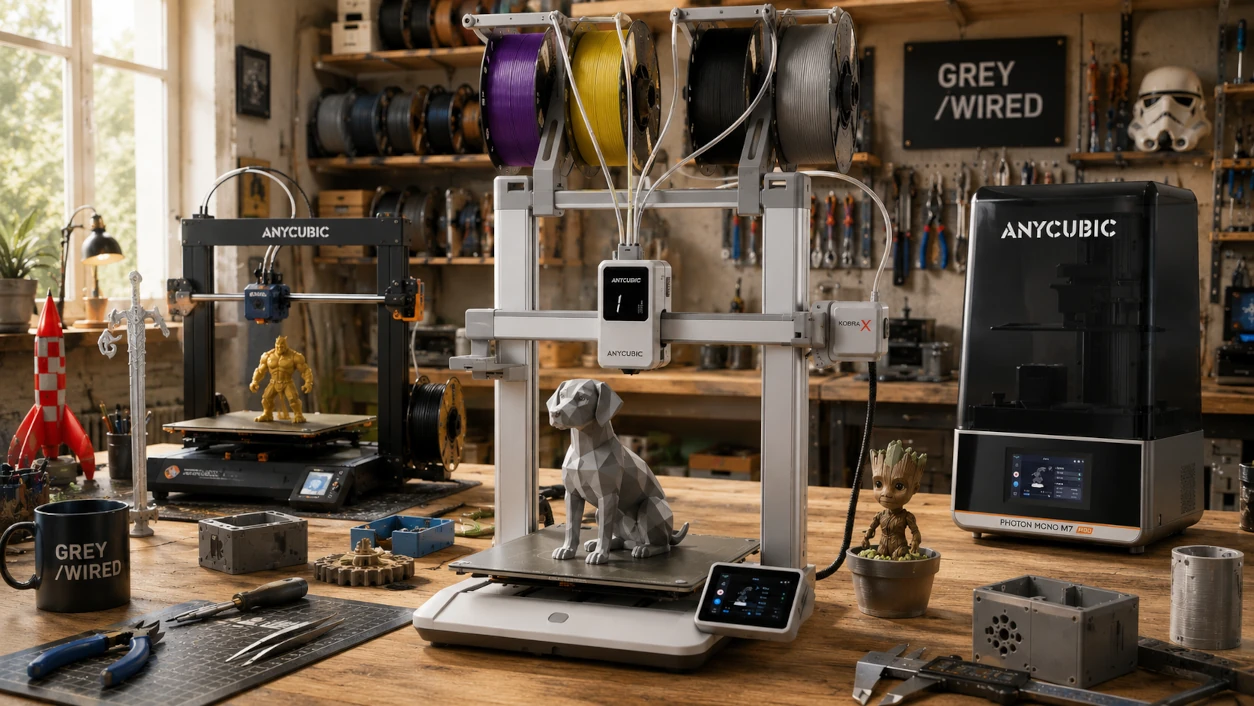
An Anycubic and its companion module therefore joined the workshop.
The Prusa didn't disappear.
It still works and continues to print parts whenever they're within its capabilities.
Let's just say it works a little less these days.
For convenience, when I need to start a filament print today, I generally turn to the newer machine.
And obviously, with new capabilities available...
I had to find something to print.
A Small Rocket
Somewhere around this period, I decided to make a small personalised gift for my father.
Tintin's famous red-and-white rocket.
No particular achievement on my part this time.
I found a model I liked, printed the different sections directly in appropriately coloured filament, assembled everything and...
done.
A rocket.
Didn't even need painting.
It was around forty centimetres tall.
When I gave it to him, he was pleased.
Admittedly, he already owned a few others.
He looked at it.
Then he asked me a question.
"How big can you make one?"
I thought about it.
"Reasonably? About 1.20 metres, I think."
That was clearly the wrong answer.
"Oh yes, I'd like one that size."
Right.
A few days later, a Tintin rocket roughly 1.20 metres tall therefore appeared in my parents' house.
My father was delighted.
My mother apparently shared his enthusiasm with...
a little more restraint.
Things Start to Overlap
By this point, telling the story in strict chronological order becomes increasingly difficult.
Because things no longer really happen one after another.
When the Tintin rockets appeared, for example, another much larger print was already finished.
Well...
the printing was finished.
The project itself was still a long way from done.
I'd decided to print Frostmourne, the Lich King's sword.
Full-size.
Because a miniature would apparently have been too easy.
All the parts had come off the printer, but they still needed assembling, some of the joints needed filling, then sanding, preparation and finally painting.
Meanwhile, there was nothing preventing the printers from working on something else.
Which is how a 1.20-metre Tintin rocket can quite happily appear between the printing and painting of a roughly 1.30-metre sword.
Written down like that, it probably gives a fairly accurate picture of the workshop.
A Certain Definition of Reasonable Dimensions
Frostmourne eventually made its way onto the workbench.
Assembly, filler, sanding, preparation...
3D printing can produce impressive objects, but it doesn't magically make the joints between individual parts disappear.
The painting itself wasn't ultimately the most difficult part of the project.
The result isn't perfect.
I can still see places I could have finished better, and I'm not entirely happy with some aspects of the paint job either.
But at some point, you also have to know when to stop.
And when you're standing in front of a sword roughly 1.30 metres long and it looks pretty damn much like Frostmourne, you can probably consider the experiment reasonably successful.
It even earned the right to be hung on a wall in a corner of the living room.
I'll take that as a form of validation.
As for its size...
I'd already told my father that a 1.20-metre Tintin rocket still counted as "reasonable".
So apparently, my frame of reference for reasonable dimensions was already somewhat questionable.
The Seasonal Rotation
There's another reason why it's increasingly difficult to describe all this as a sequence of projects.
A large part of it happens in my workshop, which I've set up in the attic.
And an attic has one remarkable quality:
it makes it very easy to tell exactly which season you're in.
Painting for several hours when it's 35°C up there isn't particularly pleasant, nor is it necessarily ideal for the products involved.
At the other extreme, when the temperature gets close to 10°C, resin printing in particular starts to become rather less enthusiastic about the conditions.
Some activities therefore naturally progress in phases.
A figurine can be printed and then wait to be painted.
A filament print can wait for assembly.
Resin work can continue while something else is on hold.
Then the temperature changes, and so do the priorities.
Over time, a sort of seasonal rotation has therefore established itself in the workshop.
Well...
"Seasonal rotation" is probably the elegant way of putting it.
"Seasonal rotation of the chaos" would probably be closer to reality.
A 3D Printer Is No Longer Just a 3D Printer
And throughout all of this, there are the other projects.
Because 3D printing doesn't exist in its own little isolated universe.
When I built a Thread Border Router using ESP32 boards, the electronics could work perfectly well sitting on the workbench.
But if it was going to leave the bench and spend its life in the garage or another room in the house, it needed an enclosure.
Fusion 360.
A few measurements.
A 3D printer.
Another project involves building a connected sound level meter intended, among other things, to measure the noise from aircraft passing over the house.
The electronics work.
Great.
But if the sound level meter is going to live outdoors, it now needs an enclosure capable of protecting the electronics from the elements while still allowing the microphone to do its job properly.
Back to modelling.
Back to the printer.
That's probably the most important change since buying the Prusa.
At first, 3D printing was the project.
Today, it sometimes still is.
But very often, it has simply become a tool within another project.
And the boundary between the two isn't always very clear.
Today Is Already Yesterday
So that's roughly where the story stands as I'm writing this.
A Prusa that works less than it used to but has absolutely no intention of retiring.
A newer FDM printer that I now tend to reach for more instinctively.
A resin printer.
Fusion 360, with which relations remain complicated.
A few finished figurines.
A few others waiting their turn.
A 1.20-metre Tintin rocket at my parents' house.
A roughly 1.30-metre Frostmourne hanging on a wall in the living room.
And probably a few prints I've completely forgotten ever existed.
But all of this also has to coexist with electronics projects, home automation, DIY, things that need repairing, and things I simply want to discover...
And life outside the workshop obviously carries on in the meantime.
There's a grey ghost roaming around, in particular, who quite rightly considers his long daily walks and his own adventures considerably more important than whether a coat of primer is sufficiently dry.
So the projects move forward.
Some quickly.
Others less so.
Some sit untouched for months before something eventually brings them back to the workbench.
When I bought my first 3D printer, I mainly wanted to discover what could be done with one.
Roughly ten years later, I think the most accurate answer is still:
I have no idea.
And that's probably a good thing.
There will be more useful parts, repairs, figurines, completely unnecessary objects, reasonable ideas and others that will probably be considerably less so.
Some will fit into a few lines.
Others will open another drawer.
And like many of my projects, this one will probably never really end.
At best, it will occasionally move into pending.
Comments
No comments yet.
Add a comment