

How Much Is What You Buy Really Worth?
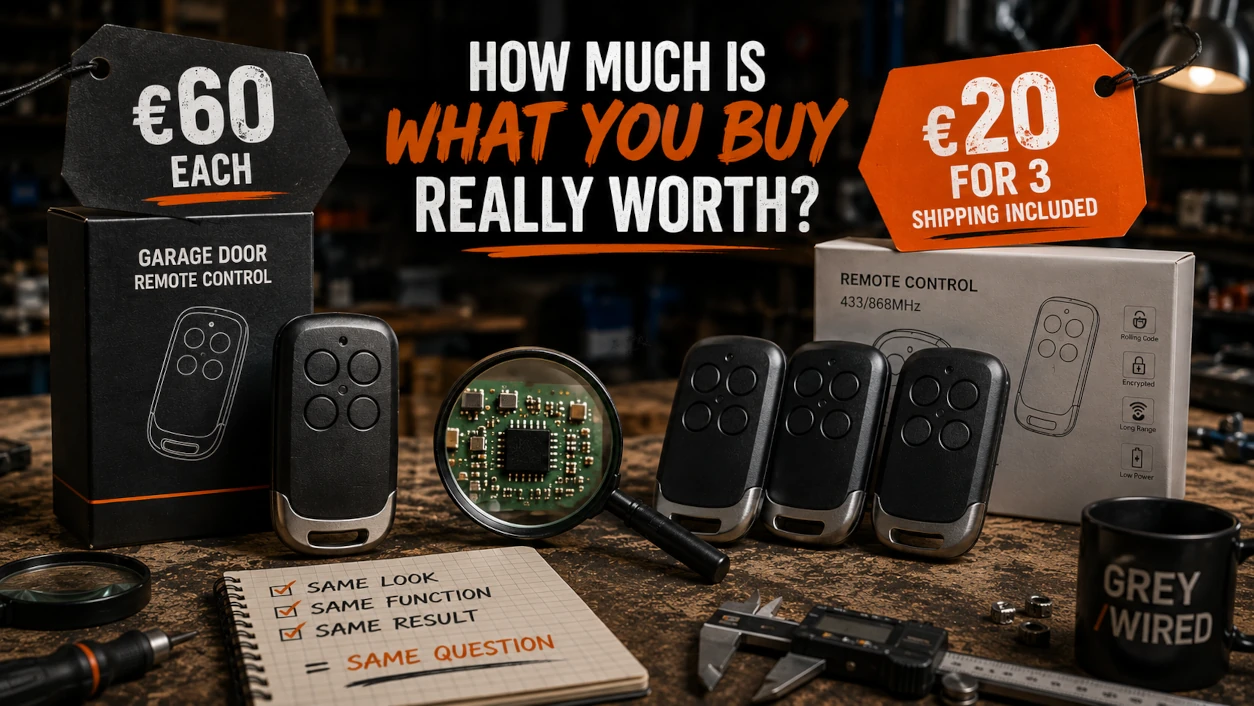
Garage Door Remotes: From €60 Each to €20 for Three
Some time ago, I thought it might be time to replace the remotes for my garage door. They're more than ten years old, have been dropped a respectable number of times, have suffered a bit of mistreatment and have been patched up as best as could be managed. In short, they still work, but they've lived.
First thing I did: check how much a replacement remote costs from the dealer. I find the model: €60 each. Ah. Luckily, they're on sale: €50 each, excluding shipping.
I'm not sure what I had imagined paying, but €50 for a small plastic case containing a few electronic components still seemed a bit steep. Especially since this remote is nothing extraordinary: it's a radio remote with rolling code and encryption, which, among other things, prevents anyone from simply recording the signal and replaying it later. A more advanced system than a fixed-code remote, admittedly, but nothing particularly exotic. I figured I should be able to find it elsewhere.
€60, €20...
New search, and I find exactly the same model on Amazon, at €20 each. That's already far more reasonable, and I could easily have stopped there: going from €50 to €20, case closed.
Except the seller was Chinese, and a question came up: if a Chinese seller can sell me this remote for €20 on Amazon, can I find it directly on AliExpress?
Yes. Same look, same remote, but this time for about €20 for all three, shipping included.
At that kind of gap, it was no longer really about saving a few euros. Mostly, I wanted to know what I would receive. It could very well be a simple copy that looks a lot like the original, but for twenty euros or so, the experiment seemed acceptable. Order placed.
A few weeks later...
A postal strike stretched the experiment out a little, but the package eventually arrived: three remotes. First surprise, the packaging looks identical to that of the originals, at least as far as my memory can judge more than ten years later.
I open a box and compare the new remote with the old one: same case, same buttons, same metal flap, same general look. I look for differences and find three. The new one has a removable protective film that I don't remember seeing on the originals. Under that film, the metal flap bears a small laser engraving with the seller's name. Finally, on the back, a label lists the remote's specifications, absent from my old ones. That's about it.
One rather important detail remains: does it work?
Thirty seconds
I start the pairing procedure with the door motor, and thirty seconds later, the new remote controls the garage door perfectly. Okay, I'm lying a little: you have to add the time it takes to find the pairing procedure online, which I had of course long forgotten. But once I found it, thirty seconds. I pick up the second one: same result. Then the third: same result. All three work perfectly.
Not just a case that looks right
This detail matters. This remote doesn't just send a fixed code that the receiver recognizes: it uses rolling code with encryption, precisely to prevent someone from recording a radio transmission in order to replay it later.
Making a piece of plastic that looks like the original remote is one thing. Making a remote that the receiver accepts during pairing, and with which it then communicates correctly using the expected protocol, is another. A successful pairing already shows that the remote speaks the expected protocol and has whatever credentials are required by the system: it isn't just a case that looks like the original.
Obviously, I can't demonstrate, without taking them apart, that the two models use the same components, or that they come from the same factory. But I have in front of me remotes that are physically almost identical to the originals, in apparently identical packaging, that pair using the normal procedure and work with the same system. The only visible differences are a commercial engraving and an identification label. Let's say this considerably reduces my concerns about compatibility.
Update, two months later: no problems. Same range, same behavior, and the cases and batteries are identical to those of the originals. Given how similar everything else is, I wouldn't be surprised if the electronics were very similar too.
So, who wins what?
This is where the story leaves me with a slightly odd feeling. My first reaction is to compare the prices, €60 each at the regular price versus about €20 for all three shipping included, and to conclude that someone is taking a gigantic margin along the way.
That would be jumping to conclusions. A local dealer can't sell at the price I find the product for directly in China: they have to import and stock the product, pay staff, rent and taxes, cover warranties, unsold inventory and administrative costs, and possibly provide advice and support. And, a detail sometimes forgotten when talking about retail margins, they also have to make a living.
I have no problem with that. I'm even willing to pay more locally when the difference brings me something: immediate availability, advice, support, a simpler warranty, or simply the certainty of buying the right product right away without spending half an hour searching. All of that has value. The question is rather: how much is it worth?
Maybe big purchases aren't where you most need to pay attention
This is probably what interests me most in this story. For a purchase of €1,000 or €2,000, I compare, and a lot: several sellers, reviews, alternatives, and I try to understand why one model costs €300 more than another. A large price gap almost automatically triggers a search.
But for a €50 remote, the reaction is more like: "Pfff... that's pretty expensive for what it is." Then you order, because you need it and know it's compatible. €50 is expensive enough for there to be a substantial markup hidden in the price, but not expensive enough for us to take the time to question it.
This mechanism goes well beyond garage remotes: accessories, consumables, adapters, cables, spare parts, filters, small components. All those unremarkable items we buy occasionally, whose price stays below our personal threshold of "Hold on, let me compare first." That may be precisely where we should sometimes do it.
€180 or €20
Had I replaced my three remotes at the dealer's regular price, the bill would have been €180 excluding shipping, or €150 with the sale. I paid about €20, shipping included, for three remotes that paired normally and do exactly what I expect of them.
That doesn't mean the gap between €20 and €180 corresponds to the dealer's profit. I don't know their purchase price, their supply chain or their costs, and claiming otherwise would be dishonest. But it does teach me something: the price at which an object is offered to me isn't necessarily a good indication of what it's really worth.
So, buy everything on AliExpress?
No, that would probably be the worst possible conclusion. There are very good reasons to buy certain products from a local or specialist dealer, and just as many to not buy certain products at the lowest price on a marketplace on the other side of the world. Safety, compliance, real quality, warranty or the plain consequences of a failure can change the equation completely. I certainly won't apply the reasoning of my garage remote to an electrical appliance or a piece of safety equipment just because an apparent equivalent costs four times less elsewhere.
But the reverse is true too: buying from the usual seller shouldn't excuse us from asking what we're actually buying, and above all what we're willing to pay for the services surrounding the object.
Five minutes
The funniest part is that I could have stopped at Amazon: remote at €60, sale at €50, same model at €20. I had already found a good deal. It took just one more search to discover that those €20 actually bought three.
So the moral isn't: "Buy everything directly from China." It's more like: "Before pulling out your credit card, sometimes take five minutes to look at what you're actually buying." Especially for those small items unremarkable enough that we don't feel like wasting time comparing them.
Five minutes may only save you a few euros, or nothing at all. But sometimes, they take the bill from €180 to €20. And at that price, I'll still have one or two perfectly essential indulgences to fund.
2026-10-06 --- Update: two months later, the remotes still work perfectly. I took the opportunity to expand the article on what this price gap really says --- and doesn't say --- about a product's value.
Comments
No comments yet.
Add a comment