
I Invited the Internet to My Blog. The Bots Showed Up.
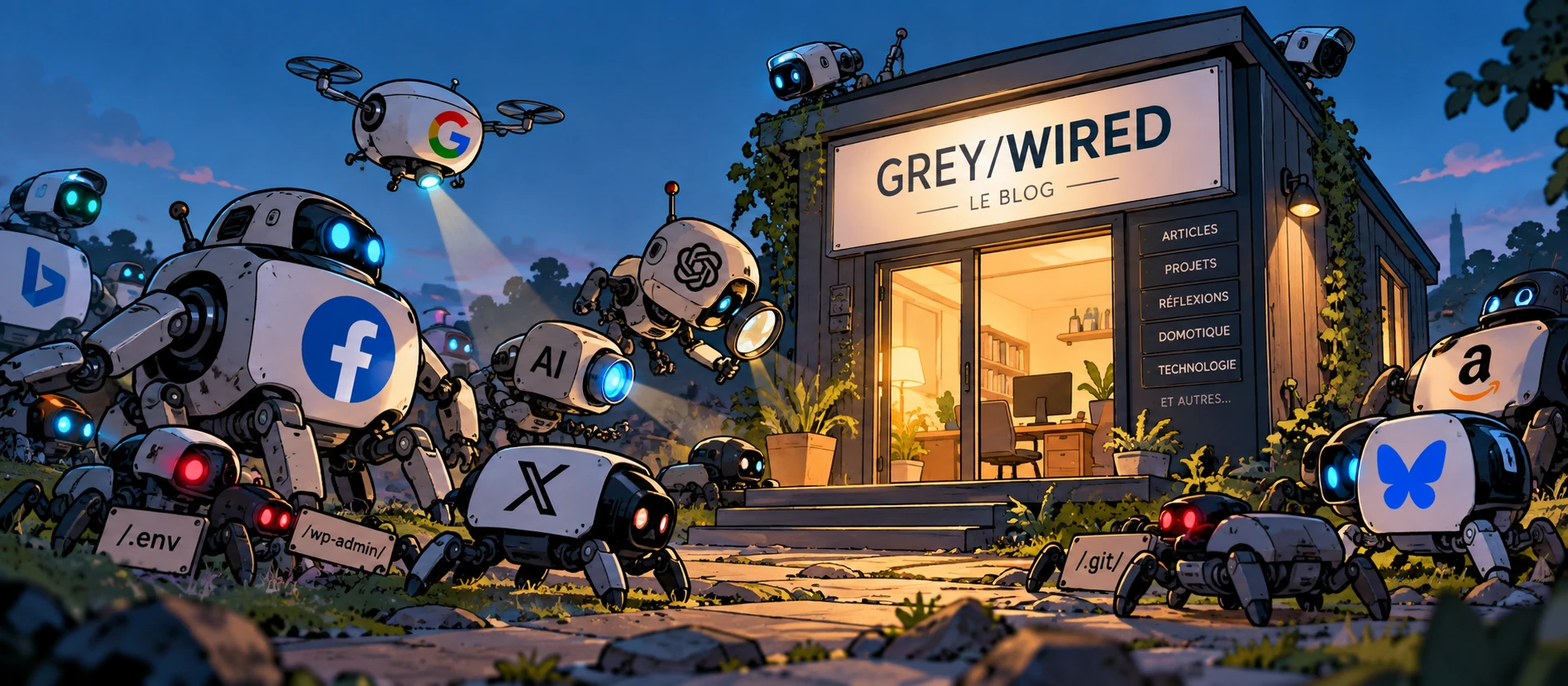
First look at my social media experiment: a few numbers, lots of bots, and still very few readers.
A few weeks ago, I decided to try a little experiment: getting GREY/WIRED noticed through social media.
I created accounts on Facebook, X and Bluesky, without linking them to my personal network. The idea was to post content regularly, without advertising, without trying to rack up followers and without any particular communication strategy. I simply wanted to see whether a few posts could spark some curiosity and bring a handful of visitors to my blog.
Between September 18 and October 12, 2026, I published 60 posts across the three platforms:
| Platform | Posts |
|---|---|
| 25 | |
| X | 25 |
| Bluesky | 10 |
| Total | 60 |
I wasn't about to turn this into a second job, either. I've got enough on my plate already.
After a little over three weeks and 60 posts, I decided to take a look at what my Apache server logs had to say.
And at first glance, it looked as though the Internet had accepted my invitation.
Well… a certain part of the Internet, anyway.
30,627 requests. Time to break out the champagne?
Between September 18 and October 12, 2026, my server recorded 30,627 HTTP requests.
For a small personal website that had only just started experimenting with social media, that might sound encouraging.
Except that an HTTP request is not a visit. Loading a single page can trigger dozens of resource requests, and a bot can crawl hundreds of URLs without a single human being ever looking at the content.
So I excluded my own IP address and local accesses, leaving 29,241 external requests.
Here's an initial breakdown:
| Traffic category | Requests | Share |
|---|---|---|
| Identified bots and tools | 13,697 | 46.8% |
| Requests targeting suspicious scan paths | 7,674 | 26.2% |
| Other, unclassified requests | 7,870 | 26.9% |
| Total | 29,241 | 100% |
This breakdown is based on tool signatures and the URLs requested. The categories are mutually exclusive: when a request targets a suspicious path, I classify it as a scan, even if its User-Agent also identifies itself as a bot.
Most importantly, that unclassified 26.9% does not represent human visitors. It includes images, JavaScript files, stylesheets and probably quite a few more bots that were considerate enough not to introduce themselves.
In other words, nearly three quarters of external traffic can already be linked to automated or suspicious activity, without even examining the rest in detail.
Facebook, search engines and a few nosy visitors
Facebook deserves a special mention. Agents identifying themselves as part of the Meta ecosystem account for around 6,300 requests, more than one fifth of all external traffic.
That's a lot.
Then there are Applebot, Googlebot, Bingbot, Ahrefs, Semrush, Amazonbot and Twitterbot, among others.
There are also bots associated with artificial intelligence, including ClaudeBot, as well as other specialized crawlers.
These automated guests roam the site, fetching pages, images and metadata, sometimes repeatedly.
At least it proves one thing: GREY/WIRED isn't invisible to machines.
But several thousand Facebook requests obviously don't mean several thousand people have discovered my articles. A platform can automatically fetch a link preview without a single user clicking through.
As for the AI bots, I find their presence rather amusing. I use AI myself to explore certain subjects and help prepare my writing, and now other automated systems come along to collect that content.
There's a certain irony in that, although I wouldn't claim that a bot downloading an article has actually read it in the human sense of the word.
The scanners certainly aren't short on curiosity
The other major category is less interested in my reflections than in possible server misconfigurations.
During the period examined, 10,891 external requests received an HTTP 404 response.
Among the paths they went looking for were a few classics:
| File or path requested | Requests observed |
|---|---|
/wordpress/ |
94 |
/.git/config |
91 |
/.env |
74 |
/.env.backup |
59 |
/index.php |
58 |
/.git/HEAD |
55 |
/.aws/credentials |
48 |
And that's just a sample. Variations on .env abound, along with attempts to access PHP files, WordPress directories and potentially sensitive configuration files.
It's quite funny when you consider that GREY/WIRED is a static website built with Astro.
So the scanners are mostly looking for things that don't exist. That doesn't stop them coming back.
Of course, this traffic is not evidence that the site is vulnerable or compromised. It mainly shows how a machine exposed to the Internet automatically attracts visitors whose intentions have nothing to do with its content.
What about actual human beings?
This was the part I really cared about.
By analyzing User-Agents, page sequences, downloaded resources and intervals between requests, I tried to identify what looked like genuine browsing sessions.
The first filtering pass produced 225 sessions showing some signs of plausible navigation. With stricter criteria, 127 retained a high technical score.
Then, focusing on sessions that included at least one article, project or short, along with resource downloads and a minimum observable duration, I ended up with 45 candidate sessions, corresponding to 38 distinct IP addresses.
To be clear: that does not mean 45 confirmed readers.
Some bots use real browsers, load images and execute scripts. Two particularly active addresses, in fact, belong to datacenter infrastructure: one at OVH in London, the other at Velia.net.
Conversely, someone who reads just one article could easily slip through the cracks of this method.
Still, a few browsing paths look fairly convincing, with several pages visited over periods of ten, twenty or forty minutes.
And this is where my own experience becomes useful: I can match some of those visits to conversations I've had or to links I've personally sent to people I know.
So some of the potentially human visits were not spontaneous at all.
My impression, after this first analysis, is that spontaneous traffic generated by social media is close to zero. I can't prove that it is strictly zero, but I have no solid reason to claim more encouraging results, either.
A conversation is not a visit
I did have a few interesting interactions on Bluesky, including an exchange with someone responding to one of my technical posts.
A genuine discussion, with comments worth taking into account.
But there's nothing in the logs that lets me attribute a blog visit to that person.
And, come to think of it, why would they have visited?
They had come across a post, we'd exchanged a few ideas, and the conversation might well have been enough in itself.
That's probably one of the most concrete lessons of this experiment: getting someone to interact on a social network doesn't mean they want to go and read the original content.
You could even have an interesting discussion with someone without ever knowing whether they visited the website.
It makes measuring things a little harder, but that's not a big deal. I'd rather have an authentic conversation than an artificially inflated visitor count.
What if the answer were much simpler?
Discussing these results got me thinking about how our relationship with reading, concentration and information consumption is changing.
It's an interesting subject, but before looking for a sociological explanation for the lack of visitors, there's a much more mundane possibility to consider.
I've published 60 posts on three social networks where almost nobody knows me.
That's a fair number of posts, but it certainly doesn't mean there were 60 genuine opportunities for someone to discover my site. Without an established audience, there's no guarantee a post will even be seen, let alone prompt a visit.
I haven't built a community, I don't actively participate in specialist groups, and I'm posting links to a personal website that is still largely unknown.
So there's nothing particularly surprising about these posts going mostly unnoticed.
The problem might simply be visibility.
Taking part in discussions on forums, home automation or electronics communities, or other specialist spaces might help me meet more people who are interested.
But that takes time, and I don't want to spend my evenings developing a social media presence. As for automating interactions to simulate community participation, that's out of the question. Even if it's technically possible, I see no point in doing it.
The aim of this experiment was never to turn GREY/WIRED into an audience-generating machine.
And I'm probably not making reading any easier
There is, however, a second hypothesis, and it's a more personal one.
I don't really write tutorials.
When I describe how I automated my blinds, installed a smart doorbell or tried to get a stubborn device working, I could probably sum up the useful information in a few paragraphs.
But that's not what interests me most.
I want to tell the story: the circumstances, the problems I encountered, the approaches I abandoned and sometimes the little absurdities that come with a technical experiment.
I'm not claiming that the solution I chose is the best one. It's simply the one I arrived at, given my knowledge, constraints and the events along the way.
Under different circumstances, I might have made completely different choices.
And I take exactly the same approach when writing about AI, dog training or other subjects that spark my curiosity.
I'm not telling people how it should be done. I'm telling the story of how I got there.
It's more of a personal account than an instruction manual.
And that sometimes leads to long articles, which ask readers to invest time and attention.
Today, though, information is constantly competing for our attention. Spending a few seconds on a social media post is one thing. Choosing to leave the feed and spend ten minutes reading someone's experience on a blog is quite another.
I see it in my own habits, too: sometimes I'll save an interesting article to read later, then never get back to it. Not because the subject has become less interesting, but simply because something else has taken its place.
Is that down to short-form content, information overload or simply our busy schedules? Probably some combination of all three, in proportions I couldn't begin to determine.
And my statistics certainly can't settle that question.
Still, I suspect the format I've chosen naturally limits the number of people willing to read what I write.
I can live with that.
Continuing the experiment
I'll carry on posting to Facebook, X and Bluesky without radically changing my approach.
I'm not going to artificially increase the number of posts, systematically shorten articles or turn my stories into content designed to please platform algorithms.
What I do want is to measure what's happening more accurately.
Apache logs remain a valuable source of information: they let me track bots, scanners, pages viewed and some browsing paths. I'd like to refine the analysis to distinguish human visitors from automated systems more reliably.
Using links tagged with UTM parameters could also help me identify visits from the different platforms, even when browsers don't send a referrer.
That would let me compare results in a few months: changes in request volumes, plausible human visitors, traffic sources and perhaps some discoveries through search engines.
I'll also keep a record of how many posts I publish on each network. That's essential if I want to compare results that would otherwise mean very little.
This first report isn't enough to write off social media as a way of introducing people to a blog. It simply describes what I've observed after a few weeks, with three new accounts and deliberately limited promotion.
So, what's the verdict?
60 posts in a little over three weeks. More than 30,000 HTTP requests. And still no significant spontaneous audience I can identify with confidence.
These figures don't tell the whole story. They don't measure how many people actually saw my posts or how much interest they might have generated. They simply show that, under the conditions of this experiment, posting content has not translated into clearly identifiable human visits.
I'd hoped that some of my experiences or reflections might interest a few people. For now, I have little evidence that social media is helping to make that happen.
But GREY/WIRED is, first and foremost, a personal project: somewhere I enjoy documenting my experiments, organizing my thoughts and sometimes questioning my own conclusions.
Meanwhile, I invited the Internet to my blog. And so far, it's mostly the bots that have shown up.
Comments
No comments yet.
Add a comment