
She Just Wanted a Switch

A while ago, I was wandering through the smart home section at IKEA.
Not because I needed a switch.
I was actually browsing the shelves for potential new “toys” to bring home when I overheard two women talking next to me.
One of them was looking for a new remote for an IKEA light fixture she had bought a few years earlier. Listening to them discuss the various boxes in front of them, they mostly seemed unsure about what was still compatible with what.
Eventually, I stepped in.
I asked whether her setup was compatible with Thread/Matter.
The look on her face immediately told me that I had probably just made the situation even less clear.
In hindsight, she was absolutely right.
She just wanted a switch.
When a simple question isn't simple anymore
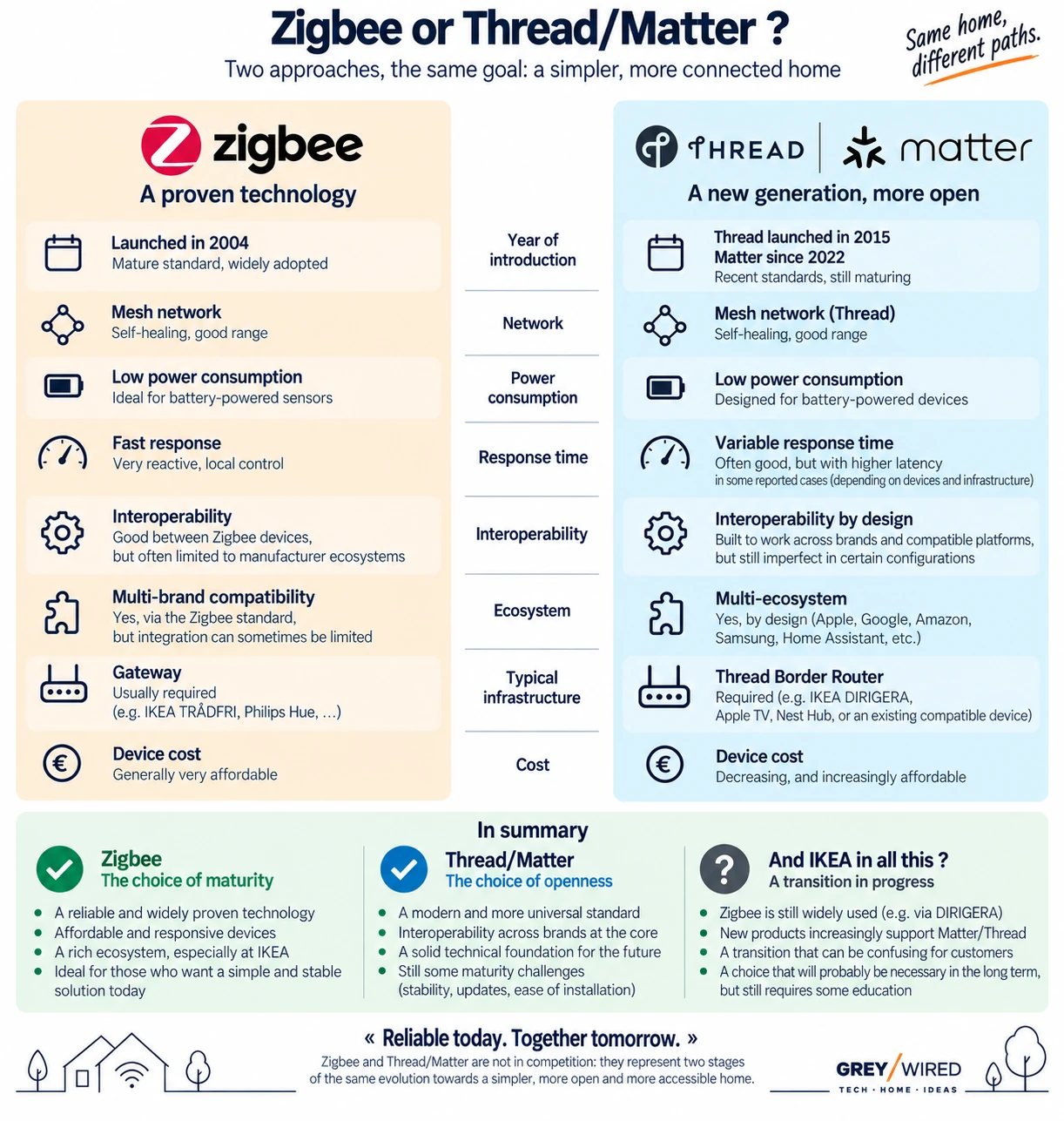
For years, IKEA's smart home ecosystem was largely built around Zigbee. Bulbs, remotes, sensors: a relatively unobtrusive, low-power, mesh-based technology that is now mature and thoroughly proven.
IKEA itself still describes Zigbee as providing instant response times and a very stable connection.
But the company is now engaged in a much more ambitious transition towards Matter and Thread.
And on paper, it's difficult to argue with that decision.
Matter aims to break down the silos between manufacturers. A device should no longer be “IKEA compatible”, “Apple compatible” or “Google compatible”, but simply Matter compatible.
Thread, meanwhile, provides a low-power, mesh-based IP network particularly well suited to small connected devices.
The goal is appealing: greater openness, less dependence on individual brands and, eventually, a smart home where infrastructure and devices from different manufacturers coexist naturally.
That is precisely what IKEA claims for its new range: making the smart home simpler, more open and more accessible.
The problem is that between the promise and the store shelf, there are still a few details to sort out.
Zigbee: the old thing that just works
I have to acknowledge a personal bias.
When a technology has been working properly for years, my first instinct is generally not to start looking for something to replace it.
That's probably a useful quality when you're running production systems.
It's considerably less useful when it comes to moving technology forward.
And in my case, Zigbee had given me no particular reason to replace it.
I use several battery-powered Zigbee devices, including various Sonoff products. The experience is almost boring: pair them, they appear, they work.
I hardly ever think about Zigbee.
That's probably the best compliment you can give a technology like this.
My interest in Thread/Matter actually came from somewhere else: my Nuki smart lock.
It can use Wi-Fi, but Thread is far more attractive for a battery-powered device. Low power consumption, mesh networking, IP communication: this is precisely the kind of use case where the newer architecture has something genuinely interesting to offer.
So I actually wanted Thread to convince me.
And because buying an off-the-shelf Border Router would apparently have been far too easy, I built one around an ESP32-S3 and an ESP32-C6.
A “short” article about that particular adventure is currently in preparation.
That choice obviously prevents me from blaming Matter or IKEA for every difficulty I encounter. Some of the complexity is complexity I deliberately went looking for.
But not all of it.
A few pieces of Swedish furniture in the mesh
To experiment with the new ecosystem, I bought two of IKEA's new battery-powered devices: a MYGGSPRAY motion sensor and a TIMMERFLOTTE temperature and humidity sensor.
They're not bad.
But compared with the Zigbee equivalents I already use, my user experience strongly favours the latter.
With a thermometer, a little latency isn't particularly dramatic. The temperature in my living room generally doesn't change by three degrees in 200 milliseconds.
With a motion sensor, responsiveness becomes much more noticeable.
And MYGGSPRAY hasn't exactly impressed me in that respect. Neither has its light sensor.
The IKEA products are very cheap, admittedly. But their Sonoff equivalents aren't dramatically more expensive and, unlike IKEA's devices, come with batteries included.
Nothing catastrophic.
Just not the feeling of a new generation naturally rendering the old one obsolete.
The firmware updates were more entertaining.
During some OTA updates, I practically had to move the devices right next to the antenna of my ESP32-C6 and try several times. The transfers were extremely slow.
Naturally, I suspected my own setup.
That's precisely one of the advantages of building my own Border Router: I can look under the hood.
And yet both devices are currently attached directly to it, with RSSI values of roughly -53 and -58 dBm and maximum link quality according to OpenThread.
That certainly doesn't prove IKEA was responsible for my firmware update problems.
It simply suggests that “poor radio reception” is a rather incomplete explanation.
And that sums up my current experience with Matter/Thread rather well: it works, but I still find myself wanting to look under the hood far too often.
The curious case of BILRESA
IKEA's transition also comes with a few curiosities.
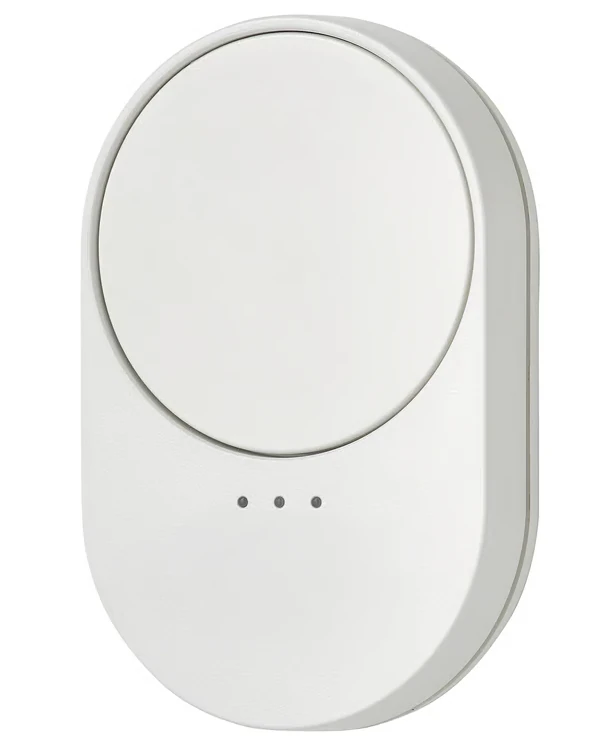
Take BILRESA, the new Matter/Thread remote.
IKEA has actually thought about coexistence with its old Zigbee world. Some functionality allows these newer controls to interact with products from the previous generation.
That's rather clever.
But it isn't particularly obvious when you're standing in front of the shelf trying to work out what to buy.
There are also less official Zigbee possibilities that can be exploited by tools such as Zigbee2MQTT. I tried using the rotary version of BILRESA this way.
It works.
Well... more or less.
I found its behaviour sufficiently unpredictable to understand perfectly well why IKEA doesn't present this as a standard mode of operation.
The result is nevertheless rather strange: the hardware is capable of maintaining certain bridges to the old world, but explaining exactly which ones, how they work and under what conditions quickly becomes complicated.
Let's go back to our lady in the store.
She has an older IKEA system. She wants to replace a remote.
To answer her question properly, do we need to know whether she has the old TRÅDFRI gateway? DIRIGERA? No gateway at all? How old is her light? Which remote does she want to buy?
And more importantly: why should she have to understand any of this?
I feel a little sorry for the salesperson
I haven't tested the level of knowledge IKEA employees have on this subject.
And I certainly don't want to put them on trial.
Quite the opposite.
An IKEA salesperson is unlikely to be a network engineer. Smart home products are probably just one of many product families they are expected to know about.
And yet answering a question as simple as “will this button work with my light?” can now require juggling TRÅDFRI, DIRIGERA, Zigbee, Thread, Matter and a few compatibility subtleties between product generations.
If a salesperson needs a crash course in IoT networking to sell a switch costing a few euros, perhaps the problem isn't their level of training.
Perhaps the answer has simply become too complicated.
And this is where I think IKEA could do a better job of supporting the transition.
Not with a poster explaining IPv6, Border Routers and IEEE 802.15.4.
Just something clearly displayed in the store:
Our smart home system is moving to Matter.
Your existing products can continue to work, but depending on your setup, you may need to check a few things before buying a new product.
A QR code, a small decision tree, four simple questions.
Customers who are interested could then dig deeper.
Everyone else could simply buy the right switch.
Because Matter is supposed to make all of this simpler
This is where my questions start to go beyond IKEA.
Matter and Thread are extremely appealing on paper.
Perhaps even too appealing.
Consider a perfectly ordinary home.
An Apple TV in the living room.
A Google Nest in the kitchen.
And now an IKEA DIRIGERA hub.
Without even knowing it, the owner may have several devices capable of acting as Thread Border Routers.
Intuitively, you might imagine one large home Thread mesh in which all these devices cooperate to improve coverage and redundancy.
That is indeed the vision.
But it isn't necessarily what happens today.
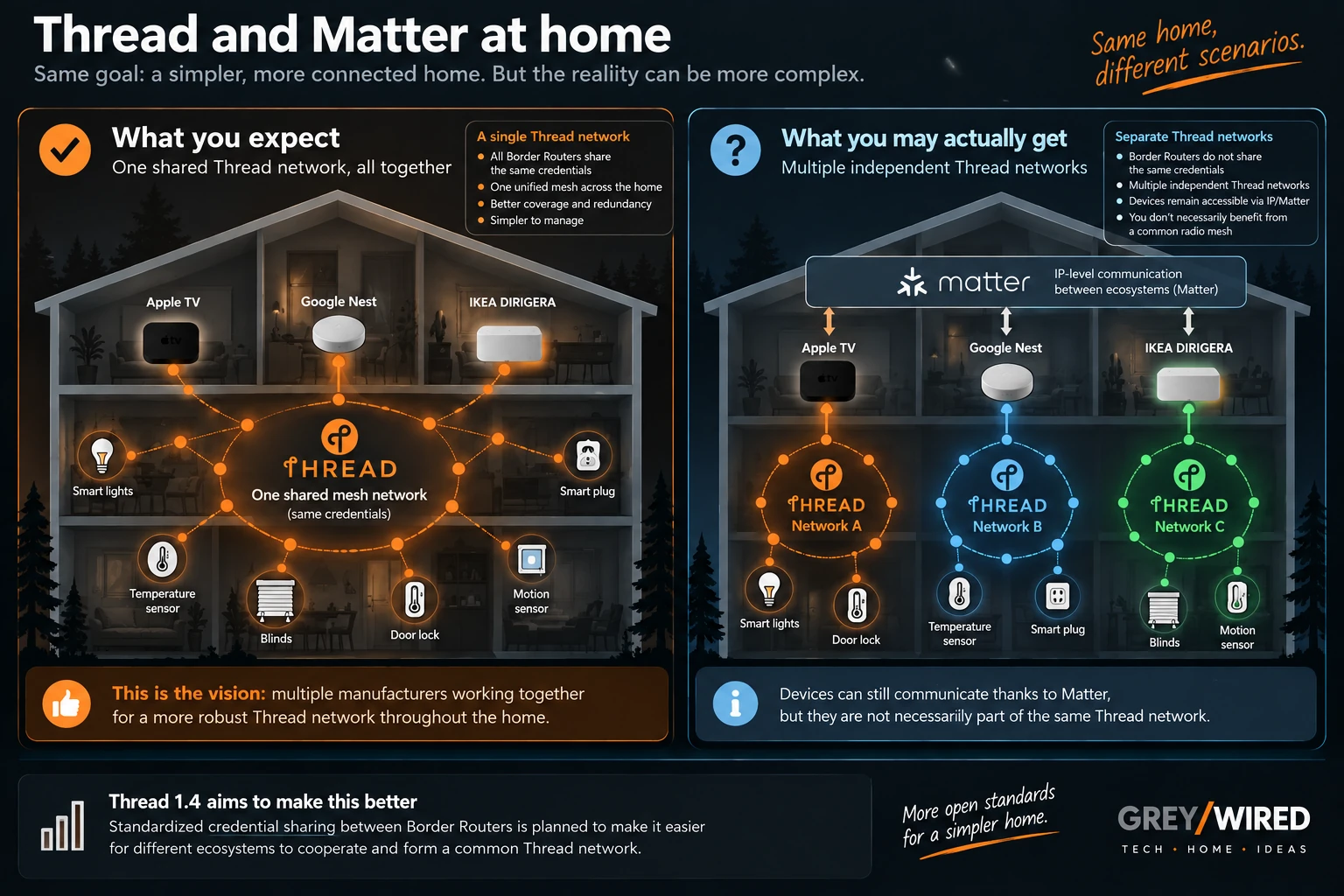
If the different Border Routers don't share the same Thread credentials, they can create several independent Thread networks. The devices remain reachable over IP and Matter can still allow them to communicate, but you don't necessarily get the large shared radio mesh you might have imagined.
This issue is real enough that Thread 1.4 specifically introduces standardized credential-sharing mechanisms between devices from different manufacturers to make it easier to create a common mesh.
That's an excellent development.
But it also raises a slightly uncomfortable question: if one of the fundamental promises is interoperability between manufacturers, why does something as essential as interoperability between the network infrastructure itself still require significant evolution before it becomes truly transparent?
Interoperability cannot stop at the devices.
It has to start with the infrastructure connecting them.
A lot of very good ideas
The more I look at Matter, the less I think its designers made bad choices.
The problem may be exactly the opposite.
Matter is trying to make a lot of good choices at the same time.
Cross-brand interoperability.
IP networking.
Low power consumption through Thread.
Mesh networking.
Multiple Border Routers.
Multiple controllers.
Multiple administrators.
Strong security.
Device authentication.
Encrypted communications.
The ability to make several ecosystems coexist without requiring implicit trust between manufacturers.
Taken individually, it's difficult to argue against any of these ideas.
Together, they inevitably create something considerably more complex.
And security is an excellent example.
Matter gives devices an identity, uses certificates, encrypts communications and precisely defines who is allowed to do what.
That's reassuring.
Certainly for my Nuki smart lock.
Although if someone really wants to get into my house, I suspect attacking the door or a window would be considerably easier than breaking the lock's cryptography.
It's the old paradox of the virtually unbreakable mechanical lock installed on a door that could be forced with a sufficiently determined shoulder.
Security isn't simply about achieving the highest possible level.
It's also about proportionality within the system as a whole.
Matter nevertheless needs to provide a common technological foundation capable of protecting both a lock that opens my house and a thermometer reporting that my living room is at 21.4°C.
I completely understand why its designers chose a strong common security baseline.
But every additional guarantee also brings certificates, credentials, trust-establishment mechanisms and constraints on future evolution.
And the devices we install in our homes today may very well still be there ten or fifteen years from now.
Cryptography, meanwhile, will continue to evolve.
That certainly isn't an argument for abandoning encryption. That would be absurd.
But it is another reason to ask how far we should push the sophistication of a system designed to connect both a door lock and a temperature sensor costing a few euros.
So, did IKEA get it wrong?
I don't think so.
Or at least, I don't think that's the right question.
IKEA could probably have remained comfortably on Zigbee for another few years.
That would probably have been easier for everyone.
But if every manufacturer waits until Matter is perfectly mature before adopting it, it may take a very long time to become mature in the first place.
With its volumes, its prices and the hundreds of millions of people who walk through its stores, IKEA is probably one of the companies capable of taking Matter out of the enthusiast world and exposing it brutally to real life.
And that's precisely how a technology matures.
I also have to acknowledge my own bias here: my natural inclination is to stick with things that work and have proved themselves.
It's comfortable.
It's reliable.
But that's obviously not how we build the next generation.
So there's a rather nice paradox here: by adopting Matter on such a large scale, IKEA is probably helping to solve some of the very problems its early customers may be experiencing today.
I can therefore believe two things at the same time:
IKEA has probably chosen the right direction.
And it may have started heading there a little too early.
An excellent promise — provided it disappears
My current feeling about Thread/Matter isn't that the technology is bad.
Quite the opposite.
I think it's extremely promising.
But its flexibility could also become its worst enemy.
When you try to make everything work with everything else, openly, securely, redundantly and independently of individual manufacturers, you inevitably build a sophisticated architecture.
The real achievement won't therefore be building that architecture.
It will be making it invisible.
With Zigbee, I quickly stopped thinking about Zigbee.
With Thread/Matter, I still think about Thread and Matter far too often.
That will probably change.
Thread 1.4 is already moving in that direction. Firmware is evolving. Manufacturers are learning. Implementations are becoming more robust.
And IKEA, with products costing only a few euros, is probably doing more than many others to accelerate that process.
But in the meantime, I also think IKEA should explain much more clearly in its stores that a transition is taking place.
Not to teach its customers about Thread.
Precisely so they don't have to learn about it.
Because after this entire detour through Zigbee, Thread, Matter, Border Routers, credentials, certificates and cryptography...
she just wanted a switch.
Comments
No comments yet.
Add a comment