
Zigbee 4.0: Lower to Reach Further
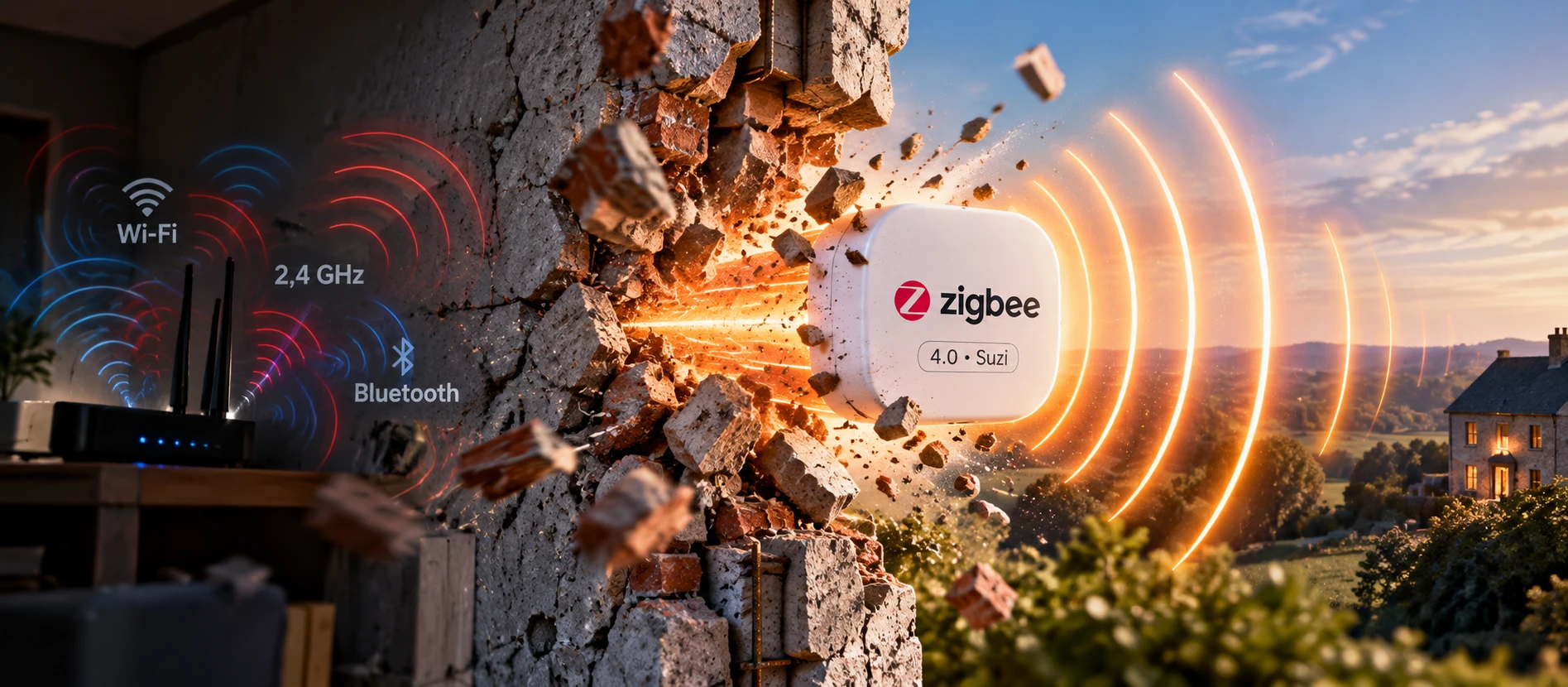
The certification of Suzi, Zigbee 4.0's new sub-GHz extension, could easily go unnoticed amid all the noise surrounding Matter and Thread.
And yet, I find it particularly interesting.
I've been using Zigbee for a while now and, in practice, I've grown to really appreciate the protocol. It's simple, reliable, the mesh network does its job and, with Zigbee2MQTT, adding a new device quickly becomes something fairly routine.
Its weak point lies elsewhere: Zigbee shares the 2.4 GHz band with Wi-Fi and plenty of other devices.
I experienced this very concretely when I started deploying Zigbee at home. Everything worked, but I still had to rearrange the channels on my Wi-Fi access points a little so that everything could coexist properly.
In a detached house, that's still relatively easy to manage.
In an apartment building, surrounded by dozens of Wi-Fi networks you obviously have no control over, things must get considerably more interesting.
And then there are the walls.
To be fair, I've never really had a problem with that at home. My Zigbee network gets through walls without any particular difficulty. But not all houses are built the same way, and when the signal has to cross several thick walls or reach an outbuilding, basement or garage, the story can be quite different.
That's precisely where Suzi gets interesting.
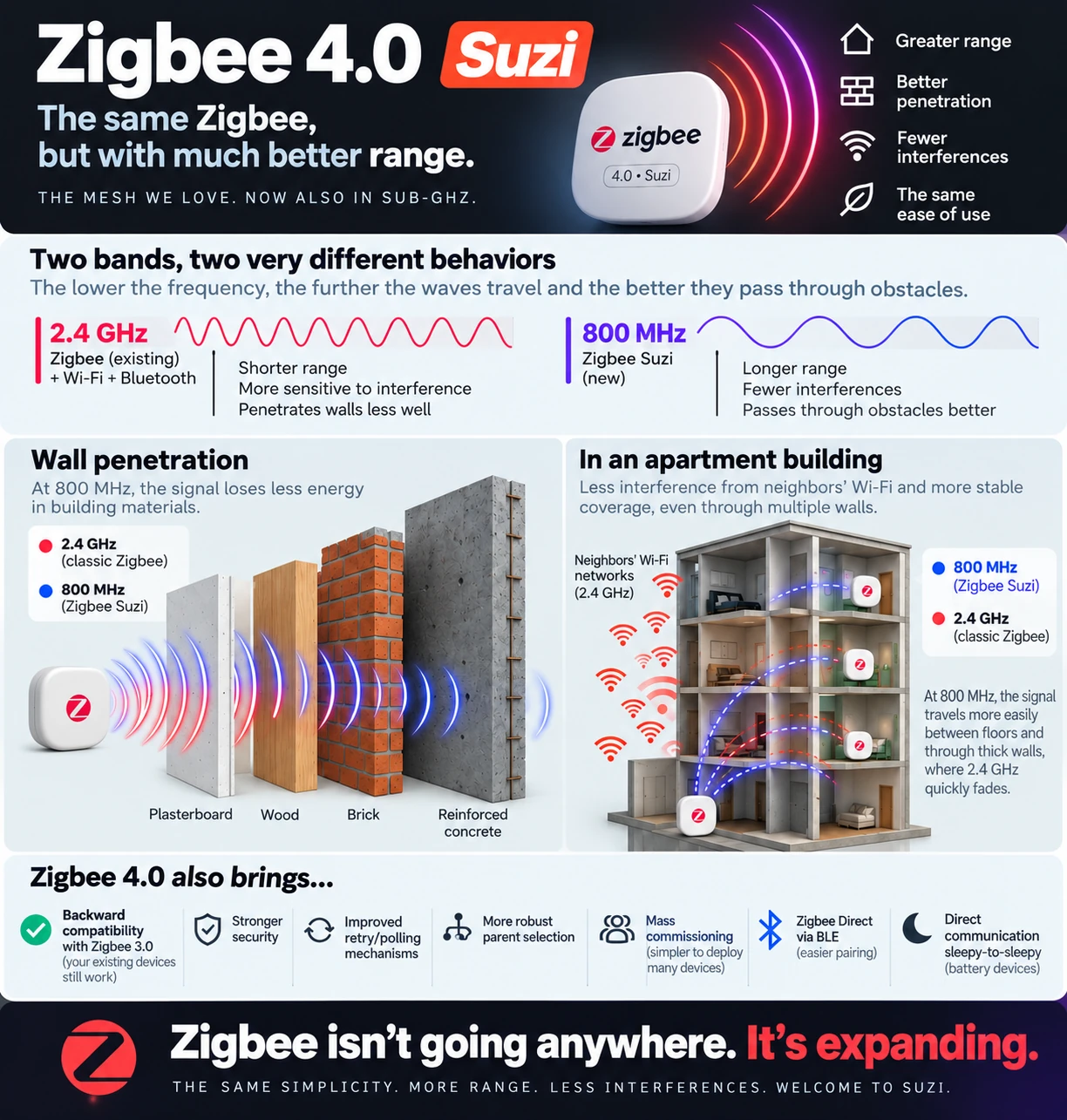
With Zigbee 4.0, the Connectivity Standards Alliance (CSA) introduces sub-GHz operation, including the 800 MHz band in Europe. A lower frequency generally means better range and better propagation through obstacles.
In other words: more range, less competition with 2.4 GHz Wi-Fi, and a better ability to get through obstacles.
You might think that a lower frequency also means lower bandwidth.
But we're not exactly watching Netflix on a door sensor.
Zigbee exchanges tiny amounts of data: a state, a temperature, a command, a few bytes of telemetry... In that context, trading bandwidth for range and robustness isn't much of a sacrifice. For the kind of applications Zigbee is designed for, the available bandwidth remains more than sufficient.
Another piece of good news: Suzi doesn't replace 2.4 GHz, it complements it. So there's no reason to throw away your existing network: current Zigbee devices will continue to work. Devices capable of supporting both radios should allow the two worlds to coexist. That said, a 2.4 GHz radio can't speak sub-GHz: to take advantage of Suzi, new compatible hardware will be required.
There is still one interesting unknown.
Moving away from 2.4 GHz allows Suzi to escape the sometimes complicated coexistence with Wi-Fi and Bluetooth. But that doesn't mean it's moving into a completely deserted part of the spectrum.
Sub-GHz is already used by plenty of devices and protocols. In Europe, the CSA refers to "800 MHz", but in practice we're talking about the 868 MHz region, a band already shared with other technologies: Z-Wave, LoRaWAN, remote controls, alarm systems... It's also subject to limits on transmission time (duty cycle), which could matter for a somewhat chatty mesh network. If Suzi becomes as successful as its technical appeal suggests it might, it will be interesting to see how all these networks coexist in environments where this part of the spectrum is already quite busy.
The amount of traffic generated by a Zigbee network remains very small, which clearly works in its favour. But after moving Zigbee away from the 2.4 GHz traffic jams, it would be rather ironic if we eventually managed to create new traffic jams one floor down.
On paper, this might look like a fairly modest evolution.
In practice, I think it could address one of the main shortcomings I've encountered with Zigbee.
While Matter and Thread have been getting much of the attention over the past few years, Zigbee doesn't seem remotely ready for retirement.
It's simply moving down in frequency.
Suzi certification only opened in early September 2026, which means manufacturers can now bring certified products to market (official CSA announcement). But between the launch of a certification programme and having a real choice of products on store shelves, some time may still pass.
For anyone currently struggling with range, several difficult walls to cross, or a particularly crowded 2.4 GHz environment, this is definitely good news.
Suzi seems to offer a rather elegant answer to some of Zigbee's main limitations, without calling into question what already works very well.
Now we just have to wait for the first devices, install a few of them, and see how all of this performs in the real world.
And that's something I really want to experiment with myself.
Comments
No comments yet.
Add a comment